To pave a steep asphalt driveway, keep the grade at or under 15 percent, build a deeper 8 to 12 inch compacted base, set drainage before paving, lay about 3 inches of asphalt in two bonded lifts with a coarse, broom-textured surface for grip, and support the lower edge. Plan quantities with our asphalt calculator first.
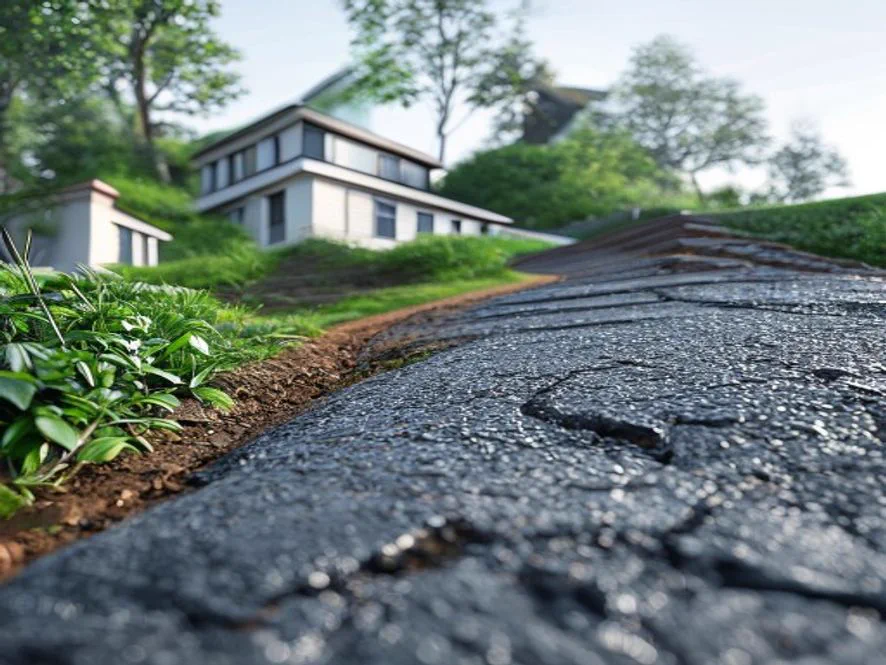
How steep is too steep for an asphalt driveway?
Slope is measured as percent grade, which is the rise in inches divided by the run in inches, times 100. A 15 percent grade rises about 1.8 inches per foot. That number matters because it decides whether the driveway is safe to use and practical to build.
- Up to 15 percent is comfortable. Cars climb and brake without drama, and the hot asphalt rolls cleanly during paving. This is the target for any driveway you can design from scratch.
- 15 to 20 percent is workable but needs care. Traction in rain and ice drops, low cars can scrape at the top and bottom, and the crew has to roll carefully so the mat does not slide. Texture and transitions become essential.
- Above 20 to 25 percent is the practical limit. Asphalt can technically be laid this steep, but it is hard to compact without sliding, hard to drive in winter, and many codes will not allow it. Our slope and grade guide walks through measuring your own number.
Before you commit to a design, check local code. Many municipalities cap residential driveway grade near 15 percent for safety and emergency access, and some require a flatter landing where the driveway meets the road. A quick call to the permit office saves a redesign later. See our driveway permit guide for what to ask.
Why a steep driveway needs a stronger build
A flat driveway only fights weather and traffic. A steep one adds two forces that attack the same place, the base and the lower edge, so it has to be built stronger from the ground up.
- Fast runoff scours the base. Water gains speed on a slope, races down the surface and along the edges, and washes the fine particles out of the aggregate base. A washed-out base loses support and the asphalt cracks. This is the number one reason steep driveways fail early.
- Gravity drags the mat downhill. Asphalt is flexible, especially when warm, so on a grade the whole mat can creep downhill a fraction of an inch at a time, stretching and tearing the surface. A hot climate makes it worse. Our hill cracking fix covers that failure in detail.
- The lower edge takes the load. Runoff and the creeping mat both push toward the bottom edge. With no curb or compacted shoulder behind it, the edge crumbles and cracks march inward, the problem our edge crumbling fix addresses.
- Freeze-thaw multiplies everything. Water in cracks or a wet base freezes, expands, and pries the asphalt apart. The FHWA pavement program documents how moisture and frost drive base failure, and a slope concentrates that water exactly where the asphalt is weakest.
Mini-tool
Driveway Grade and Grip Check
Enter the rise and run to get the percent grade, then see whether it is comfortable, workable, or near the limit and what to plan for. This is a planning guide, not a substitute for an on-site look.
Step by step: how to pave a steep driveway
Work in this order. The base, drainage, and surface texture steps are what separate a steep driveway that grips and lasts from one that cracks and turns into an ice slide.
- Confirm the grade and check code. Measure the slope as percent grade and keep it at or under 15 percent where the layout allows. Check local code first, since many areas cap driveway grade near 15 percent and may require a flatter landing at the road.
- Build a deep, compacted base. Excavate and lay 8 to 12 inches of crushed aggregate base, compacting it in lifts. A slope needs more base than a flat driveway because water tries to wash it out. Our base prep guide covers compaction.
- Set drainage before you pave. Cut a channel drain across the top, add a French drain along the high side, and grade a slight cross-pitch so water sheds to one edge. Our drainage solutions and French drain guide show the layout.
- Pave in two lifts with a tack coat. Lay a binder course, then a surface course, totaling around 3 inches, with a tack coat between them so the lifts bond and resist downhill creep. See our layers explained guide.
- Use a coarse mix and broom the surface. Choose a surface mix with coarser aggregate and drag a light broom across the asphalt while it is still warm to leave a textured, grippy finish that holds in rain and ice.
- Support the edges and smooth the transitions. Build a compacted gravel shoulder or a poured curb along the lower edge so it cannot crumble, and ease the transitions at the top and bottom so low cars do not scrape and tires keep traction.
- Cure, then sealcoat on schedule. Let the asphalt cure and keep traffic off as your contractor directs. Once it has aged a season, sealcoat to lock water out of the base. Our when to sealcoat new asphalt guide has the timing.
Mix and thickness for a slope
A steep driveway should be built thicker and tougher than a flat one. The base does the structural work, so a slope gets 8 to 12 inches of compacted crushed stone instead of the 4 to 8 inches a flat residential driveway might use. On top, plan about 3 inches of asphalt in two lifts: a binder course with larger aggregate for strength, then a surface course for the finish.
The surface mix matters for grip. A finer, smoother mix looks tidy but turns slick when wet. A surface course with coarser aggregate, finished with a light broom drag while warm, leaves a micro-texture that gives tires something to bite. The tack coat between the binder and surface lifts is not optional on a slope. A well bonded mat resists the downhill creep that tears a steep driveway apart. If you tow or park heavy vehicles, go thicker still and read our RV and heavy vehicle thickness guide. For the general numbers, see residential thickness.
Drainage is the real fix on a slope
If you do one thing right on a steep driveway, control the water. Nearly every failure on a grade traces back to runoff getting into or under the asphalt. The National Asphalt Pavement Association notes that keeping water out of the structure is the core of asphalt longevity, and a slope makes that harder by speeding water up and concentrating it.
The priority is intercepting water before it ever touches the driveway. A channel drain across the top, set into the asphalt and tied to a pipe that carries flow to daylight, takes the road and yard runoff out of the equation. Along the high side, a French drain catches groundwater that would push up into the base. On the surface, a deliberate cross-pitch of about 2 percent sends rain to one edge in a few feet instead of letting it race the full length and gain force. Where the slope flattens at the bottom, a catch basin handles the runoff that collects there. Our standing water fix covers that low-spot problem.
Keeping a steep driveway safe in winter
A steep driveway is most dangerous when wet or iced. The texture you build in during paving is the first line of defense, but winter habits matter too. Use sand for traction rather than relying only on salt, since heavy salt and freeze-thaw both stress asphalt. The CDC notes that falls on slick surfaces are a common home injury, and a steep, icy slope raises that risk for everyone who walks it.
Clear snow promptly so it does not pack into ice, plow or shovel with a technique that does not gouge the surface, and keep the drains clear so meltwater runs off instead of refreezing on the slope. Our winter protection guide and sand vs salt for traction guide cover the routine. In a hot climate the opposite problem appears: the mat softens and creeps, so read our hot climate care guide to keep it firm.
What a steep driveway costs to pave
Expect to pay more than a flat driveway of the same size, often 20 to 50 percent more. The premium comes from the heavier base, the drainage work, edge support, and the slower, more careful paving and rolling a grade requires. Typical 2026 ranges for the steep-specific extras:
- Deeper base and excavation: several hundred to a few thousand dollars more than a flat build, depending on length and how much cut and fill the grade needs.
- Channel or trench drain across the top: 500 to 2,000 dollars installed, depending on length and outlet.
- French drain along the high side: 1,000 to 3,000 dollars depending on length and depth.
- Edge support or curb: 600 to 2,500 dollars for the lower edge.
- Whole steep driveway: commonly 5,000 to 15,000 dollars or more for a typical residential slope, driven by length, access, and drainage.
Get planning numbers from the driveway cost calculator, and run any contractor bid through the quote checker so the drainage and base work do not get padded with extras you do not need. Hire carefully too: a steep driveway exposes a weak crew fast, so use our contractor guide to vet bids.
Bottom line
A steep driveway can be paved in asphalt and last for decades, but it has to be built for the grade. Keep the slope at or under 15 percent where you can, build a deeper compacted base, set drainage before you pave, lay the asphalt in two bonded lifts with a coarse broom-textured surface for grip, and support the lower edge. Get the base, the water, and the texture right and a steep driveway is safe and durable. Skip them and gravity and runoff will crack it and turn it slick within a few seasons.