The ideal asphalt driveway slope is 2 to 5 percent, meaning 2 to 5 inches of fall per 10 feet of run. That sheds water without puddling and still drives flat. The minimum for drainage is about 1 percent, and most codes cap the maximum near 12 to 15 percent before a driveway becomes too steep. Plan drainage alongside grade.
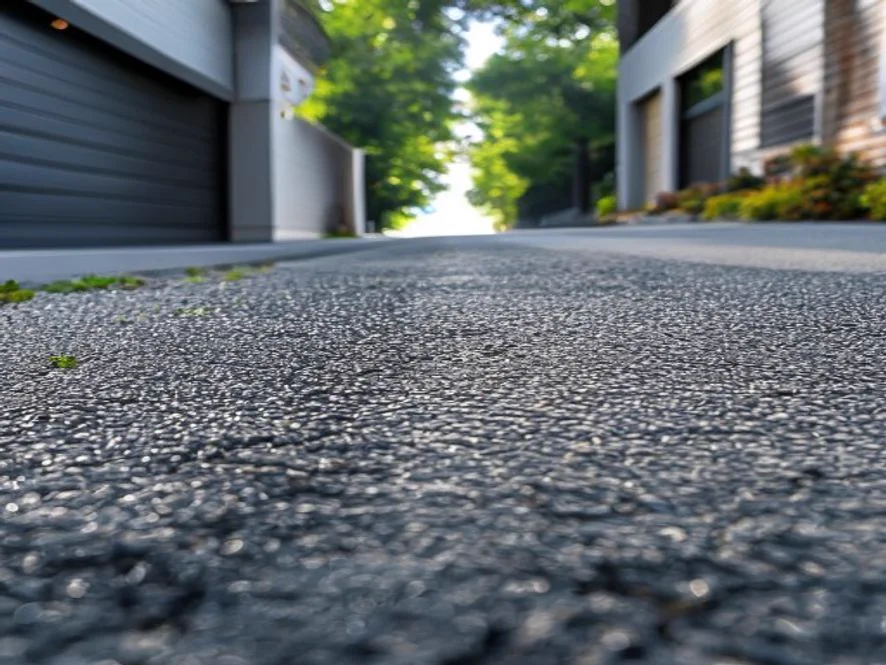
What is the ideal slope for an asphalt driveway?
For most homes, the sweet spot is a 2 to 5 percent grade. Slope is just rise over run expressed as a percent, so a 2 percent grade drops 2 inches for every 100 inches of length, or roughly 2 inches per 10 feet. At that pitch, rain runs off on its own, you never feel like you are climbing, and the asphalt sits flat enough to park a car without it rolling.
Grade has two directions that both matter. The running slope is the pitch along the length of the driveway, usually from the garage down toward the street. The cross slope is a gentle tilt across the width, often 1 to 2 percent, that pushes water off one side instead of letting it sheet straight down the middle. A good install builds in both so water always has somewhere to go.
- 2 to 5 percent running slope: the comfortable ideal for drainage and driving.
- 1 to 2 percent cross slope: tilts water off the surface toward a lawn, swale, or drain.
- Pitch away from the garage and house: water should never run toward your foundation or garage door.
What is the minimum slope a driveway needs to drain?
The practical minimum is about 1 percent, which is roughly 1 inch of fall over 8 to 10 feet. Anything flatter and water has no reason to move, so it pools. Those puddles are the early stage of a birdbath low spot, and standing water is the number one cause of premature cracking and surface failure on otherwise good asphalt.
Builders aim a little above the bare minimum on purpose. A driveway settles a small amount in its first year or two, and a 1 percent grade can flatten into a 0.5 percent grade that no longer drains. Starting at 1.5 to 2 percent leaves a safety margin so the surface still sheds water after minor settling. If your existing driveway already holds standing water, the slope is almost certainly too shallow somewhere.
How steep is too steep for a driveway?
On the high end, most local codes and experienced pavers treat 12 to 15 percent as the practical ceiling for a residential driveway. The Federal Highway Administration publishes grade guidance for roads, and driveways generally stay well below highway maximums because they are short and used at low speed. Past 15 percent, three problems stack up fast.
- Ground clearance: low cars and the transition where a steep driveway meets a flat street will scrape the bumper or undercarriage.
- Winter traction: ice and snow turn a steep grade dangerous. A car can slide down before tires bite. See our steep driveway paving guide.
- Pavability: hot asphalt wants to slide downhill before it cools. Above 15 percent the crew needs a stiffer mix and extra care to get a smooth, even mat.
Anything over about 20 percent is considered very steep and usually needs engineered transitions at the top and bottom, channel drains across the run, and sometimes a textured finish for grip. Some homeowners on extreme grades choose a different surface, which is worth weighing in our asphalt vs concrete comparison.
How do I measure my driveway slope?
You do not need a survey crew. Slope is rise divided by run, times 100, for a percent. The rise is the vertical drop from the high point to the low point. The run is the horizontal distance between those two points. Divide and multiply, and you have your grade.
- Board and level method: rest one end of a long straight board on the high point. Raise the low end until a level reads flat, then measure the gap from the board to the ground. A 4 inch gap under a 4 foot board is an 8 percent grade.
- String line method: stake a level string from the top, then measure down to the surface at the bottom. Drop divided by string length gives the slope.
- Phone app: most phones have a built in level or inclinometer that reads degrees. Multiply the tangent of the angle by 100, or just use the tool below.
Use the calculator below to turn a simple rise and run measurement into a grade percent, and to see whether your number lands in the ideal, flat, or steep range.
Slope tool
Driveway Grade Calculator
Enter the vertical drop and the horizontal length of your driveway to get the grade as a percent, plus a quick read on whether it is in range.
Planning guidance only. Check local code for the maximum allowed driveway grade in your area before you pave.
Why slope decides how long your driveway lasts
Grade is not just about comfort. It controls where water goes, and water is what destroys asphalt. A driveway that drains stays dry between rains, so the base under it stays firm and the surface never softens. A driveway that pools holds water against the asphalt, which works into hairline cracks, freezes, expands, and tears the surface apart over the seasons.
In freeze-thaw climates the stakes are higher. Trapped water that freezes and expands drives freeze-thaw damage and can lift sections through frost heave. Good slope keeps water moving off the surface before it ever has the chance to sit and freeze. That is why pavers obsess over grade during the base prep and why the National Asphalt Pavement Association treats drainage as a core design factor, not an afterthought.
Fixing slope on an existing driveway
If your driveway is already in and it does not drain, you have a few options depending on how bad it is. Minor low spots that hold a thin film of water can be filled and feathered. Larger flat areas usually need an overlay that rebuilds the grade on top of the old surface, or a partial tear out and repave to re-establish proper fall.
- One or two birdbaths: patch and level the low spots. Cheapest fix when the rest drains fine.
- Broad flat zone: an overlay can be laid with a built-in slope to push water toward a new low edge.
- Water running at the garage: a trench or channel drain across the entrance protects the foundation. A french drain can intercept runoff before it reaches the house.
- Whole driveway holds water: the grade was wrong from the start, and a full repave with corrected fall is the lasting fix.
Whatever the fix, decide the target grade before any work starts and have the contractor confirm it in writing. Our paving contract checklist covers how to spell out drainage and slope so it does not get skipped.
Planning slope into a new driveway
The best time to get grade right is before the first load of asphalt arrives. During base prep, the crew shapes the gravel to the finished slope, then the asphalt simply follows it. Walk the planned grade with your contractor and look at where water leaves the property. If the natural land slopes toward your house, the design has to actively redirect that water with cross slope, swales, or a drain.
Slope also touches your budget. A steep or heavily reshaped site needs more excavation, more base, and sometimes retaining or drainage work, which adds to the bill. Run your dimensions through the driveway cost calculator to get a baseline, then use the tonnage calculator to estimate material once you know the area. Run any written estimate through the quote checker to confirm grading and drainage are actually in the price. References for the grade ranges are on the sources page.
Bottom line
Aim for a 2 to 5 percent driveway grade with a 1 to 2 percent cross slope to shed water comfortably. Never go below about 1 percent or water pools and cracks the surface, and stay under 12 to 15 percent or the driveway gets steep, slick, and hard to pave. Measure your rise and run, confirm the target slope in writing, and make sure water always runs away from the house. Slope is cheap to plan and expensive to fix later, so get it right before you pave.