Standard residential asphalt is built for cars and SUVs. RVs, boats, dump trailers, and 1-ton dually trucks concentrate weight in ways a regular driveway cannot handle long term. The fix is more compacted asphalt and more base, in the right ratio. This guide walks the thickness targets by vehicle type and the cost premium for going heavy duty. For the broader thickness story across all vehicles, see our driveway thickness page.
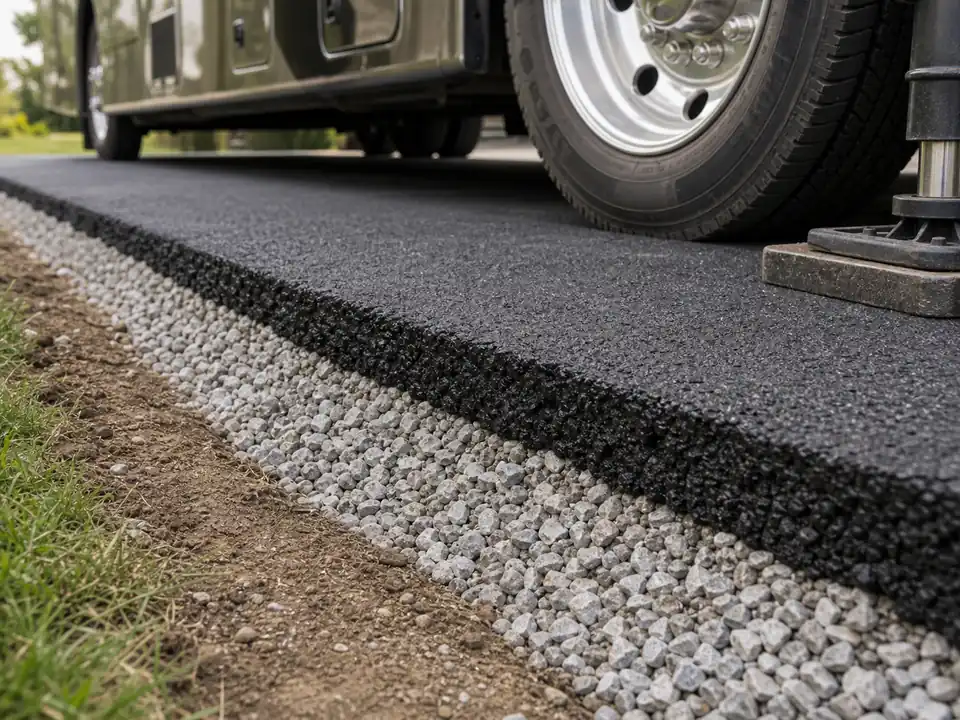
How point loads actually fail asphalt
Asphalt distributes load. A 5,000 lb car on four tires spreads weight over roughly 200 square inches of contact. A 12,000 lb travel trailer with the tongue jack on a 3 inch pad concentrates more than 1,000 lb on 9 square inches when parked. On a 95 degree day, that pressure punches through a thin asphalt section into the base. The result is a permanent dimple under every parked stay.
The Asphalt Institute publishes load-distribution data showing that compacted thickness governs how far point loads travel before they spread to the base. Thicker asphalt and a stronger base both push the failure point higher.
Thickness targets by vehicle type
| Vehicle | Compacted asphalt | Aggregate base |
|---|---|---|
| Passenger cars and small SUVs | 2.5 to 3 inches | 4 to 6 inches |
| Half-ton pickup trucks | 3 inches | 6 inches |
| Work trucks and 3/4-ton (loaded daily) | 3 to 3.5 inches | 6 inches |
| Boat trailer with V-hull | 3 inches | 6 inches |
| Travel trailer or fifth wheel | 3 to 3.5 inches | 6 to 8 inches |
| Class C or smaller Class A motorhome | 3.5 inches | 8 inches |
| Class A motorhome (35 ft plus) | 4 inches | 8 inches |
| 1-ton dually, daily commercial loads | 4 inches (or concrete) | 8 inches |
| Heavy commercial (delivery trucks) | 4 inches plus (or concrete) | 8 inches plus |
Boat trailers and loaded work trucks still need a load-spreading pad under the jack or foot stand. Weight times frequency is what pushes heavy commercial use toward concrete.
Base matters as much as asphalt thickness
The base does most of the structural work. Doubling the base from 4 inches to 8 inches gains more lifespan than adding an inch of asphalt. A 3 inch driveway over 8 inches of crushed stone outperforms a 4 inch driveway over 4 inches of crushed stone for heavy vehicles.
Standard residential base is 4 to 6 inches of compacted crushed aggregate. Heavy duty calls for 6 to 8 inches. In freeze-thaw climates with weak subgrade soil, 10 to 12 inches is reasonable. The Federal Highway Administration publishes pavement structural number guidance that scales depth with expected load.
Other heavy-duty design rules
- Subgrade prep is non-negotiable. Soft subgrade pumps under load. Remove organics, compact the soil, then build the base.
- Drainage matters more on heavy-duty pads. Saturated base under a heavy load is how alligator cracking starts. Re-grade for drainage even on small pads.
- Use load-spreading pads under jacks. Even on a thick driveway, a 12 by 12 inch wood or composite pad under the tongue jack adds an extra layer of insurance.
- Avoid hot summer setup. Above 90 degrees Fahrenheit, asphalt softens. Setting up the trailer mid-summer is when most dents happen. Move the foot to a pad in the morning before heat sets in. The National Weather Service hourly forecasts are the easiest way to find that pre-heat window.
- Cure time is longer for thicker sections. A 4 inch section needs the full 6 to 12 month cure window before heavy point loads. See curing time.
Cost premium for heavy-duty thickness
- 1 inch extra asphalt: Adds roughly 1.00 to 2.00 dollars per square foot.
- 2 inches extra base aggregate: Adds 0.50 to 1.50 dollars per square foot.
- Combined (1 inch asphalt plus 2 inch base): 1.50 to 3.50 dollars per square foot premium.
- Typical 360 sq ft RV pad premium: About 600 to 1,200 dollars over standard build.
- Typical 1,000 sq ft heavy-duty driveway premium: About 1,500 to 3,500 dollars over standard build.
Run your build numbers through the cost calculator using the heavy-duty thickness in the input.
When concrete is the better answer
- Hot southern climates where asphalt softens regularly above 90 degrees.
- Daily heavy commercial loading (delivery trucks, dump trailers).
- Long-term Class A motorhome storage with the tongue or jacks loaded for months.
- Sites where you want zero point-load risk.
For the broader picture, read asphalt vs concrete driveway 2026.
Asking the contractor the right questions
- "What compacted asphalt thickness will you spec for my heaviest vehicle?"
- "What base depth and base material will you use?"
- "Will you compact the subgrade before laying base?"
- "What is the warranty on the heavy-duty section?"
Score every quote against the same scope using our quote checker.
References for the thickness targets and load distribution data are on the sources page.