Standing water pools on an asphalt driveway when the surface lacks enough slope, has settled into a low spot, or the surrounding ground blocks runoff. Fix it by filling shallow birdbaths with cold patch, regrading deep dips, or adding a French drain where water has nowhere to go. Acting early prevents costly cracking.
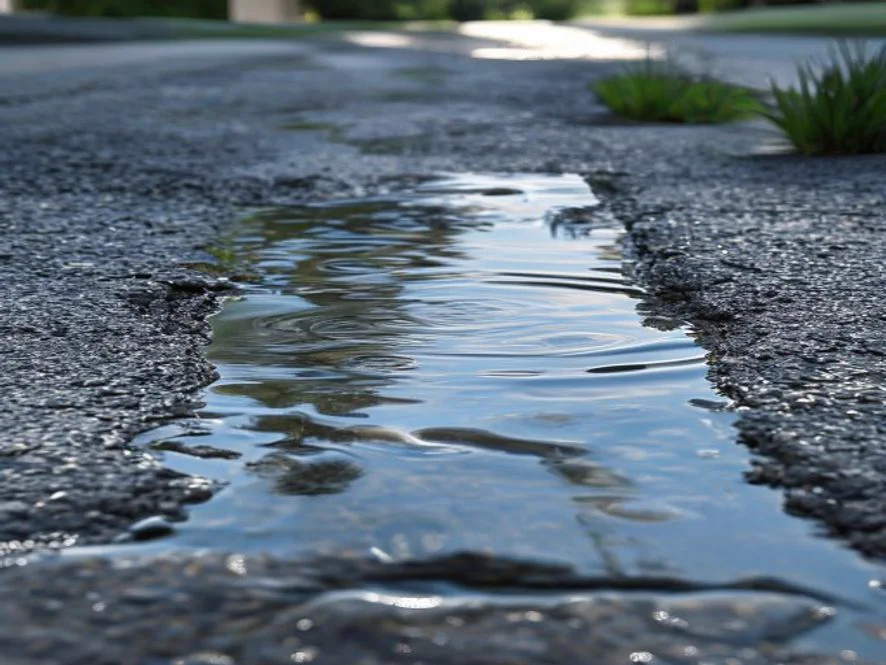
Why is water pooling on my asphalt driveway?
Asphalt is designed to shed water, not hold it. A well built driveway has a slope of at least 1 to 2 percent, which is about a quarter inch of fall per foot, so water runs off to the edges or street. When you see puddles, one of a few things has gone wrong. Knowing the cause tells you whether you need a small patch or a bigger drainage project.
- Not enough slope. The surface is too flat to move water. This is usually a build or design issue. See our guide to driveway slope and grade percent for target numbers.
- Settling and low spots. Soft or poorly compacted base sinks over time, creating birdbaths. Soft, wet ground or buried debris under the pavement is a common trigger. Learn more about asphalt settling and how to fix it.
- Birdbaths from install errors. A roller that sat too long or an uneven screed leaves dished areas. These often show up in the first year. Our birdbath and low spot repair guide covers the patch.
- Blocked or higher surrounding grade. A lawn, garden bed, or sidewalk that sits higher than the driveway edge traps water on the pavement with nowhere to drain.
- Clogged or missing drains. A channel drain or culvert packed with leaves and grit backs water up onto the surface.
Is standing water actually bad for asphalt?
Yes, and it is one of the fastest ways to wreck a driveway. Asphalt is held together by a petroleum binder. Sitting water seeps through the surface and into hairline cracks, washes out the fine material in the base, and softens the ground below. In cold regions the trapped water freezes and expands, prying the pavement apart in a process the Federal Highway Administration documents as a top cause of pavement failure. You can read how the agency frames moisture and freeze damage at the FHWA site.
Left alone, a birdbath usually progresses from a stain, to surface cracking, to alligator cracking, and finally a pothole. Standing water also breeds moss and algae, makes ice patches worse in winter, and can become a mosquito breeding site, which the CDC flags as a yard health concern. The takeaway is simple. Standing water is never cosmetic only. It is a slow leak in your driveway budget.
How much pooling is normal?
A thin sheet of water that drains within a few minutes of rain stopping is fine. That is the slope doing its job. Use these rough thresholds to decide if you have a real problem.
- Depth. Less than a quarter inch and gone fast is normal. A quarter inch or deeper that lingers is a low spot.
- Size. A puddle smaller than a dinner plate is minor. Anything the size of a car tire or larger needs attention.
- Time. If water sits more than 24 hours after the rain ends, the area cannot drain on its own and will keep degrading.
The quickest test is the hose test. Run a hose over a dry driveway, shut it off, and watch where water stays. Mark every lingering puddle with chalk. Those marks are your repair map. This is also a key item on any spring inspection checklist.
Quick check
Ponding Severity Estimator
Enter what you see after rain. This tool gives a rough read on whether you can DIY or should call a pro, plus a ballpark cost range.
How to fix a low spot holding water (step by step)
For a shallow birdbath under about half an inch deep, this is a weekend DIY job. Pick a dry stretch with at least 48 hours of no rain and temperatures above 50 degrees Fahrenheit so the patch cures.
- 1. Find and mark the low spot. Hose the driveway, let it drain, and circle every lingering puddle with chalk.
- 2. Clean and dry it. Sweep, scrub with driveway cleaner, rinse, and let it dry fully. Our driveway cleaning guide covers the prep.
- 3. Seal cracks first. Fill any cracks inside the dip with crack filler so water stops undermining the base. See how to seal cracks.
- 4. Fill the depression. Pour cold patch or a pourable asphalt leveler, building it slightly proud of the surface to allow for compaction.
- 5. Tamp it level. Compact with a hand tamper or rented plate compactor and check with a straightedge so water now sheds toward the edge.
- 6. Cure and test. Let it cure per the label, then hose it again to confirm the water drains.
If the dip is deeper than half an inch, spans a large area, or you have several puddles, this becomes a pro skim coat or regrade. Trying to build up thick layers of cold patch by hand rarely lasts. For a primer on the patch itself, read how to patch a pothole, which uses the same materials.
When you need a drainage solution instead of a patch
Sometimes the asphalt is fine but the water has nowhere to go. If the puddle forms at the base of a slope, against a garage, or where the lawn sits higher than the driveway, a patch will not help. You need to give the water a path. Common fixes, roughly cheapest to priciest, include the following.
- Regrade the surrounding ground. Lowering a flower bed or cutting a swale in the lawn can let trapped water escape for very little money.
- Trench or channel drain. A linear grate set across the low point carries water to daylight or a pipe. Budget roughly 1,000 to 2,500 dollars installed.
- French drain. A gravel trench with perforated pipe pulls subsurface water away. Our French drain guide walks through it, and the full menu of options is in driveway drainage solutions.
- Mill and overlay or regrade the asphalt. When the slope itself is wrong, a contractor mills the surface and lays a new layer pitched to drain. This is the most thorough and most expensive route.
For broad guidance on building water away from foundations and pavement, the EPA stormwater pages are a solid neutral reference. If your area floods, permeable options exist too, covered in our permeable asphalt guide.
What does fixing standing water cost?
Cost depends entirely on whether you are patching a dip or moving water. Use these 2026 ballparks to set expectations before you call anyone.
- DIY birdbath patch. 20 to 60 dollars in cold patch and crack filler.
- Pro skim coat or low spot repair. 300 to 800 dollars depending on area.
- Channel or French drain. 1,000 to 3,500 dollars installed.
- Regrade or partial repave. 3,000 dollars and up, sized to the area.
To sanity check any quote you get, run it through our quote checker and price the materials with the asphalt calculator. If the fix turns into a larger resurfacing job, our resurfacing cost guide helps you budget.
How to prevent ponding from coming back
Once you have fixed the puddle, keep it gone. Sealcoat every 2 to 4 years to keep water from soaking in, fill cracks the moment they appear, and keep edge drains and grates clear of leaves. Stick to a regular maintenance schedule and do a hose test each spring. Catching a quarter inch dip early is a 30 dollar fix. Ignoring it for two winters can mean a 5,000 dollar repave.
Bottom line
Standing water is a warning light, not a cosmetic flaw. A shallow birdbath is a cheap weekend patch. A deep dip, a wrong slope, or trapped runoff needs regrading or a drain. Either way, fixing it now is far cheaper than the cracking and potholes that follow if you let the water sit.