An asphalt driveway on a hill cracks because runoff scours the base and gravity drags the mat downhill, so the surface stretches and tears. To stop it, divert water at the top with a channel or French drain, support the edges, and grade the surface to shed water, then seal the cracks. Fix the cause first or they reopen. Start by sizing any patch with our asphalt calculator.
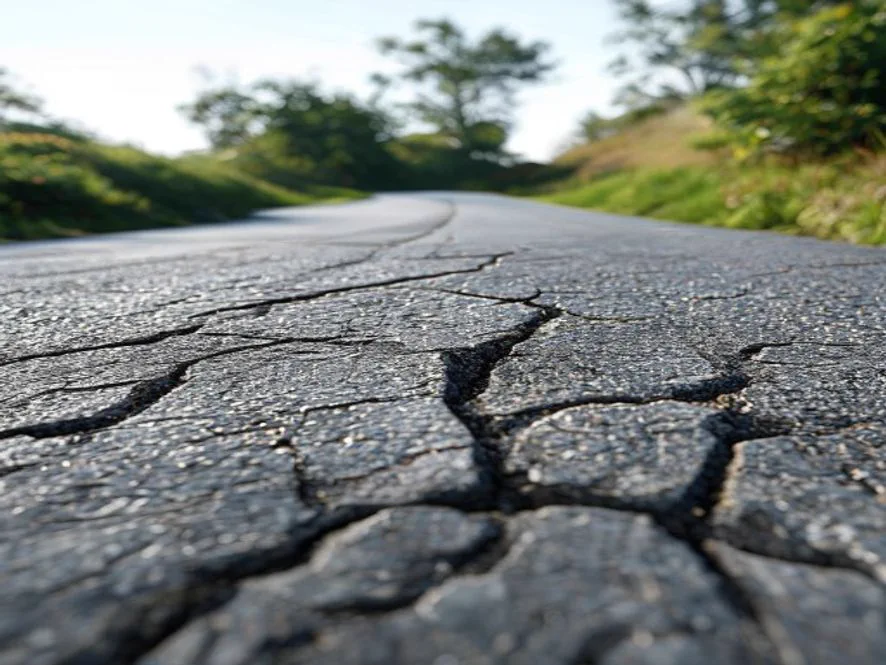
Why driveways on a hill crack faster
A flat driveway only has to survive weather and traffic. A sloped one fights two extra forces every day, and both attack the same place: the base under the asphalt and the unsupported lower edge.
- Fast runoff scours the base. Water picks up speed on a slope. Instead of soaking in slowly, it races down the surface and along the edges, washing the fine particles out of the crushed stone base. A washed-out base loses support, the asphalt flexes, and cracks open. This is the number one reason hillside driveways fail early.
- Gravity pulls the mat downhill. Asphalt is flexible, especially when warm. On a steep grade the whole mat creeps downhill a fraction of an inch at a time, stretching the surface and tearing open cracks that run across the slope. The hotter the climate, the more the mat moves in summer.
- Weak edges crumble. The lower edge of a sloped driveway takes the full weight of the runoff and the creeping mat. With no curb or compacted shoulder behind it, the edge crumbles and cracks march inward. See our edge crumbling fix for that specific failure.
- Freeze-thaw multiplies everything. Water that sits in cracks or a wet base freezes, expands, and pries the asphalt apart, then drains and leaves the base looser. The FHWA pavement program documents how moisture and frost drive base failure, and a slope concentrates that water exactly where the asphalt is weakest.
How to read the cracks on a slope
The direction and pattern of the cracks tell you whether you are fighting movement, a failed base, or just surface shrinkage. Match what you see before you choose a repair.
- Cracks running across the slope (side to side). The classic sign of a creeping mat. The asphalt is sliding downhill and pulling apart. Sealing alone will not hold unless you stop the movement with edge support and drainage.
- Long cracks running down the slope. Often a cold seam from the original paving or base shrinkage. These let water straight into the base, so seal them early. Our crack-type guide covers each pattern.
- Cracking concentrated at the lower edge. Edge failure from unsupported shoulders and runoff. The fix is edge support, not just filler.
- Interconnected scaly cracking (alligator). The base has failed under that area. This needs cut-out and base repair, not surface work. See alligator cracking fix.
Walk the driveway during and right after a heavy rain. Where you see water sheeting fast, pooling, or undercutting an edge is exactly where the next cracks will form. That walk is the most useful diagnostic you can do, and it costs nothing.
Mini-tool
Hill Driveway Crack Triage
Enter the slope, the widest crack, and what water does on the surface to get a likely repair path. This is a planning guide, not a replacement for an on-site look.
Step by step: stop a hillside driveway from cracking
Work in this order. The water and edge steps are what separate a repair that holds from one that reopens by next spring.
- Divert the water at the top. Most runoff that damages a sloped driveway comes from above it, off the yard or the road. Cut a channel drain or trench drain across the top edge so that water never reaches the asphalt, and add a French drain along the high side. Our French drain guide and drainage solutions cover the layout.
- Shed water off the surface. Grade the driveway with a slight crown or a cross-pitch of about 2 percent so water runs to one side and off, not the full length down the middle. The slope and grade guide explains the target numbers.
- Support the lower edge. Build up a compacted gravel shoulder, a paver border, or a poured curb behind the lower edge so it cannot crumble outward. Edge support also resists the downhill creep of the mat.
- Clean and fill the cracks. Once water is handled, blow or wire-brush the cracks clean, then fill anything up to about half an inch with a pourable crack filler. Wider cracks need the steps in our large crack repair guide.
- Repair failed sections. For alligator areas or soft spots, cut out the section, rebuild and compact the base in two-inch lifts, and re-pave with hot mix. Our repair guide walks through it.
- Sealcoat the whole slope. Once cracks are filled and any patch has cured, sealcoat to lock surface water out. On a steep grade, use a squeegee or brush rather than spray so the coat does not run downhill, and seal on a dry, mild day.
Drainage is the real fix on a hill
If you only do one thing for a sloped driveway, control the water. Every other failure on a hill traces back to runoff getting into or under the asphalt. The National Asphalt Pavement Association notes that keeping water out of the structure is the core of asphalt longevity, and a slope makes that harder by speeding water up and concentrating it.
The priority is intercepting the water before it ever touches the driveway. A channel drain across the top, set into the asphalt and tied to a pipe that carries flow to daylight or a drain, takes the road and yard runoff out of the equation. Along the high side, a French drain catches groundwater that would otherwise push up into the base. On the surface itself, a deliberate cross-pitch sends rain to one edge in a few feet instead of letting it race the full length and gain force. Standing water at the bottom, where the slope flattens, often needs its own catch basin. Our standing water fix covers that low-spot problem.
What it costs to fix and prevent cracking on a slope
Cost tracks the cause. Crack filling is cheap. Stopping the water and supporting the edge is where a sloped driveway costs more than a flat one, but it is also what makes the repair last. Typical 2026 ranges:
- DIY crack fill and sealcoat: 80 to 300 dollars in materials for an average driveway.
- Channel or trench drain across the top: 500 to 2,000 dollars installed, depending on length and outlet.
- French drain along the high side: 1,000 to 3,000 dollars depending on length and depth.
- Edge support or curb: 600 to 2,500 dollars for the lower edge.
- Cut-out and base repair of a failed section: 500 to 2,000 dollars per section.
- Resurface or rebuild a steep driveway: more than a flat one because of access, grading, and the extra base work. Weigh it with our resurface vs replace guide.
Get planning numbers from the driveway cost calculator, and run any contractor bid through the quote checker so drainage and base work do not get padded with extras you do not need.
Keep a hillside driveway from cracking again
Once the water and edges are handled, a few habits keep a sloped driveway sound for years longer.
- Clear the drains. A channel drain or French drain full of leaves and grit does nothing. Flush them twice a year so runoff keeps moving past the driveway.
- Seal on schedule. A sound sealcoat keeps water out of fine cracks before it reaches the base. Plan it with our maintenance schedule.
- Fill cracks early. On a slope a hairline crack becomes a water channel fast. Fill new cracks the season they appear.
- Watch the lower edge. Top up the gravel shoulder if it erodes and keep vegetation off the edge so the support stays intact.
- Mind the heat. Warm asphalt creeps more on a grade. If you are in a hot climate, our hot climate care guide covers keeping the mat firm.
Bottom line
A driveway on a hill cracks because of forces a flat one never faces: fast runoff scouring the base and gravity dragging the mat downhill. Read the cracks to find the cause, divert the water at the top, support the lower edge, grade the surface to shed water, then fill and seal. Handle the water and the edges first and the cracks stay closed. Skip them and you will be sealing the same lines every spring while the base keeps washing away underneath.