Driveway resurfacing in 2026 spans three levels with very different price tags. Sealcoat at 0.15 to 0.25 dollars per sq ft. Overlay at 3 to 7. Mill and overlay at 4 to 8. The right choice depends on the condition of the existing surface and base. This guide walks each level, what it actually does, what it costs, and how to decide. Drop your area into the cost calculator for a personal number, and see the full 2026 cost report for a new-driveway baseline to compare against.
The three levels at a glance
Each level fixes a different problem. The wrong level for the wrong problem either wastes money or fails early. The resurface vs replace decision tree covers the upstream call. Below is the cost frame for a 1,000 sq ft driveway in 2026.
- Sealcoat: 0.15 to 0.25 dollars per sq ft. 150 to 250 dollars for 1,000 sq ft. Lifespan 3 to 5 years.
- Overlay: 3 to 7 dollars per sq ft. 3,000 to 7,000 dollars for 1,000 sq ft. Lifespan 8 to 15 years.
- Mill and overlay: 4 to 8 dollars per sq ft. 4,000 to 8,000 dollars for 1,000 sq ft. Lifespan 10 to 18 years.
For the full replacement number above these, see driveway replacement cost in 2026. For tear-out only, see cost to remove an old asphalt driveway.
Level 1: Sealcoat
Sealcoat is the cosmetic level. A thin liquid coat is squeegeed or sprayed across the existing surface. It restores the black color, slows UV oxidation, and helps shed water. It is not a structural fix. Sealcoat will not fill cracks wider than a hairline. The DIY sealcoating guide and DIY sealcoating mistakes cover the application side.
- Pro sealcoat cost: 0.15 to 0.25 dollars per sq ft installed. 150 to 250 on a typical driveway.
- DIY sealcoat cost: 50 to 120 dollars in materials. Time cost is real on hot, dry days.
- Crack fill add-on: 0.50 to 1.50 dollars per linear ft. Always done before sealcoat.
- When to pick: Surface is sound. Cracks are isolated and under a quarter inch. Color is faded. Last sealcoat was over 3 years ago.
- Lifespan: 3 to 5 years before the next coat.
Sealer chemistry matters. See coal tar vs asphalt emulsion for the binder choice. Most US suburban markets have moved toward asphalt emulsion for environmental reasons.
Level 2: Overlay
Overlay is the real resurfacing step. A 1.5 to 2 inch lift of new hot mix asphalt is paved over the existing driveway. The existing surface stays in place and acts as a base. Surface cracks are buried. Color and ride are reset. This only works if the existing base is sound and the surface is not too high already.
- Overlay cost: 3 to 7 dollars per sq ft installed. 3,000 to 7,000 on a typical 1,000 sq ft driveway.
- Material: About 8 to 11 tons of hot mix for a 1,000 sq ft driveway at 2 inches compacted.
- Crack prep: Wide cracks are filled before the overlay so they do not reflect through. Reflection cracking is still possible within 2 to 5 years.
- When to pick: Surface cracks are widespread but the base is firm. No alligator cracking on more than 30 percent of the area. Apron at the street still ties in.
- Lifespan: 8 to 15 years on a sound base.
The total driveway thickness rises with an overlay. If the apron at the street is fixed by code, or if a garage threshold is close to the existing surface, overlay can be the wrong choice. That is where mill and overlay comes in.
Level 3: Mill and overlay
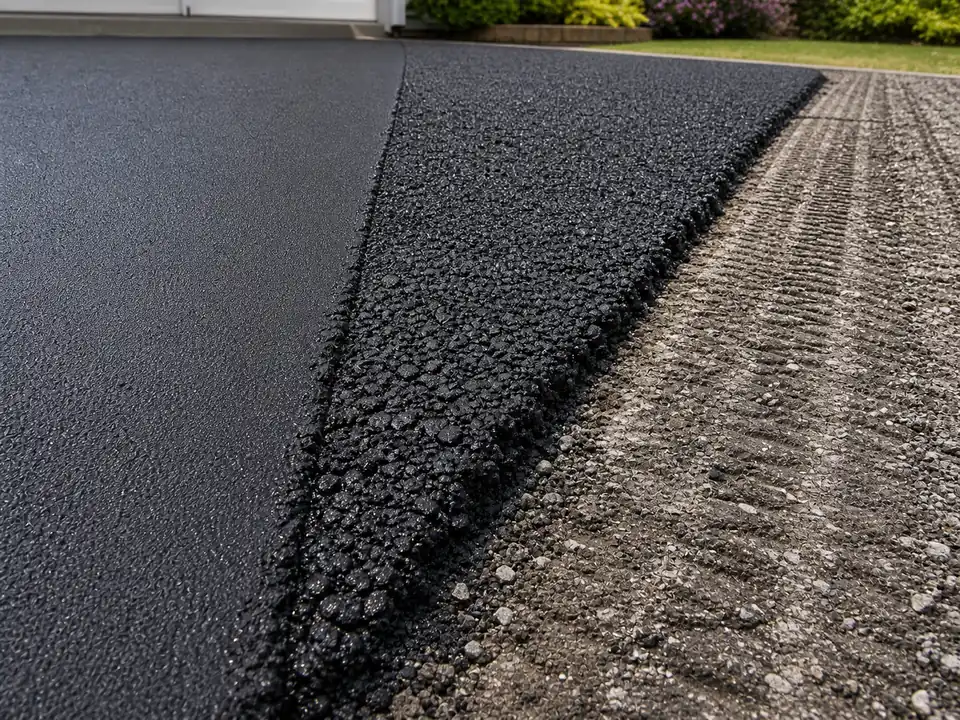
Mill and overlay removes the top 1 to 2 inches of the existing surface with a cold planer, then places a new 1.5 to 2 inch overlay flush with the surrounding grades. It is the right pick when the existing surface is rough, when overall thickness matters, or when the transition to the apron or garage cannot be raised.
- Mill and overlay cost: 4 to 8 dollars per sq ft installed. 4,000 to 8,000 on 1,000 sq ft.
- Milling adds: About 1 dollar per sq ft above a plain overlay.
- Recycled millings: Often hauled to the contractor's yard for reuse. Some homeowners ask for the millings to keep for a rural pad. See asphalt millings vs gravel.
- When to pick: Surface is rough. Flush transitions matter. Existing driveway is already at full thickness. Heavy raveling on the surface needs to leave before the new layer goes down.
- Lifespan: 10 to 18 years.
The National Asphalt Pavement Association publishes overlay and mill-and-overlay design guidance for residential and commercial work. The FHWA pavement program documents the same techniques at the highway scale.
How to pick the right level
The decision tree is short. Walk the driveway with a tape and a pen.
- Are there alligator cracks over more than 30 percent of the surface? If yes, skip resurfacing. Read driveway replacement cost.
- Are there multiple low spots that hold water? If yes, the base has failed. Replacement is the right call.
- Is the surface rough, raveling, or already at full thickness? If yes, mill and overlay.
- Are surface cracks widespread but the base is firm? If yes, overlay.
- Is the surface sound and only faded? If yes, sealcoat plus crack fill is enough.
The resurface vs replace decision tree covers the threshold cases. For age-based judgment, see how long an asphalt driveway lasts.
What changes the rate
- Driveway size: Small jobs cost more per sq ft. Mobilization for a paver and roller is a fixed cost. See cost by size.
- Region: Northeast and West Coast labor markets run 1 to 3 dollars per sq ft over the South and Midwest.
- Season: Shoulder season (March or November) drops the rate 5 to 15 percent. See best time to pave.
- Crack prep depth: Heavy crack fill or root removal before overlay can add 200 to 1,000 dollars.
- Hauling distance: Plants more than 30 miles away add a hauling premium.
Resurfacing cost by driveway size
Apply the per-sq-ft ranges to your own area. Small driveways carry a fixed mobilization cost that lifts the rate. Big driveways dilute it.
- 500 sq ft small driveway: Sealcoat 75 to 125. Overlay 1,750 to 3,750. Mill and overlay 2,250 to 4,250.
- 1,000 sq ft standard residential: Sealcoat 150 to 250. Overlay 3,000 to 7,000. Mill and overlay 4,000 to 8,000.
- 1,500 sq ft mid-size suburban: Sealcoat 225 to 375. Overlay 4,500 to 10,500. Mill and overlay 6,000 to 12,000.
- 2,000 sq ft long rural driveway: Sealcoat 300 to 500. Overlay 6,000 to 14,000. Mill and overlay 8,000 to 16,000.
The cost by size table covers the install-only side. Resurfacing skips the tear-out and base lines, which is where the savings come from.
What a resurfacing day looks like
For a sealcoat, a crew arrives around 7 am, blows debris off the surface, fills cracks if needed, and applies two coats by squeegee or spray. The driveway is closed to foot traffic for 12 to 24 hours and to vehicle traffic for 24 to 48. For an overlay, the crew arrives with a paver, roller, and dump truck. The existing surface is swept and a tack coat is sprayed. Hot mix is laid in one pass for a small driveway, two passes for a wider one. The roller follows on the same shift. A 1,000 sq ft overlay finishes in a single working day. The driveway is closed to vehicles for 24 to 72 hours depending on temperature.
For mill and overlay, the cold planer runs first and grinds the top 1 to 2 inches into a truck. Then the paver crew follows behind. The two-step sequence pushes the project to a single long day or two short days. The warranty guide covers what a contractor should guarantee on the new surface.
Get a clean quote
Hand each contractor the same scope sheet. Same area. Same lift thickness. Same crack prep. Same edge work. Use the quote comparison guide for the line-by-line method. Score the final quote with the quote checker. Check the contractor on the Better Business Bureau for complaint history. Pull a written contract with payment milestones, per the FTC home improvement contract guide. The contractor selection guide and the warranty guide cover the vetting and warranty terms.
Bottom line
Resurfacing is three different jobs sold under one word. Pick the level by what is wrong with the surface. Sealcoat fixes color and slows wear. Overlay buries surface cracks. Mill and overlay does both and keeps the thickness flush. None of them fix a failed base. For the install-only baseline, see the real bill. For the full tear-out math, see driveway replacement cost.
Mix design, lift thickness, and aggregate references are on the sources page.