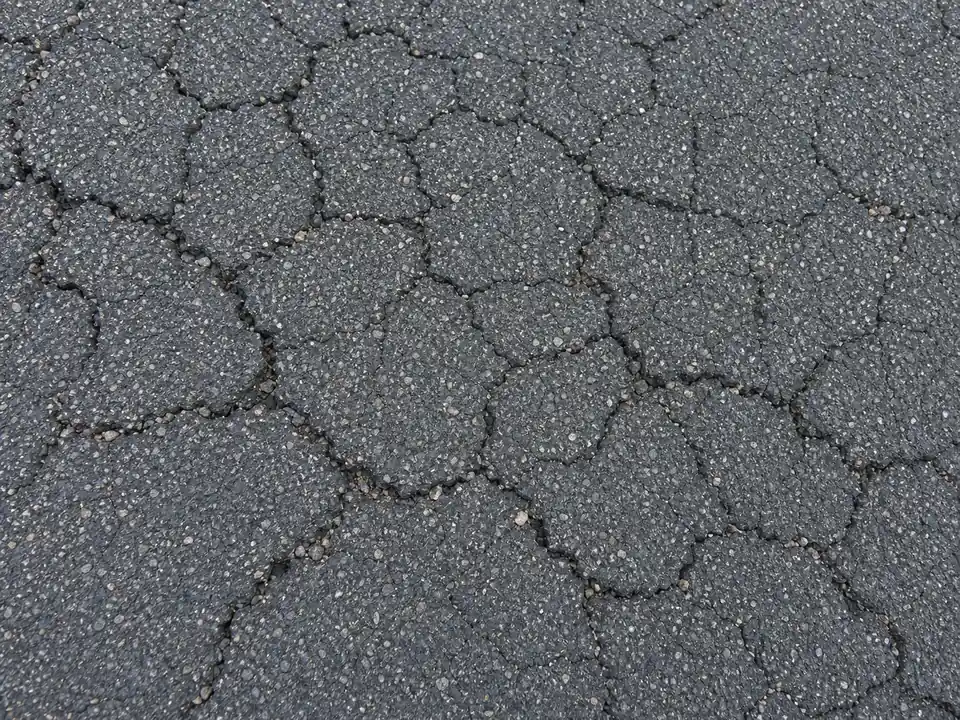
Alligator cracking on an asphalt driveway is fatigue failure of the base under the surface, not a surface flaw. It is caused by a weak or thin base, poor drainage, or loads too heavy for the asphalt thickness. The only durable fix is to cut out the failed area, repair the base, and re-pave. To see how it compares with other patterns, read types of asphalt driveway cracks.
What does alligator cracking actually mean?
Alligator cracking, sometimes called fatigue cracking, is a network of interconnected cracks that break the surface into small blocks resembling reptile skin or chicken wire. It is not random aging. It is the asphalt flexing under load over and over until it fractures from the bottom up. The Asphalt Institute classifies this as a structural distress, which is the key point: the surface is the last thing to fail, not the first. By the time you see the pattern on top, the base below has already lost its strength.
That is why this matters more than a single crack or a low spot. A hairline crack is cosmetic. A birdbath low spot is drainage. Alligator cracking is the driveway telling you its foundation is giving out under that patch.
What causes it?
Four root causes show up again and again, and most jobs have more than one at once.
- Weak or thin base. If the crushed-stone base was too shallow or poorly compacted, it cannot spread vehicle loads. A residential driveway usually needs 4 to 8 inches of compacted aggregate. See base prep for the right depths.
- Poor drainage. Water that pools or sits in the subgrade softens it. A soft, saturated base flexes, and the asphalt cracks. This is why alligator cracking so often appears in low areas. Drainage solutions covers the fixes.
- Asphalt laid too thin. A surface course of only an inch or two over a marginal base fatigues fast. Heavy-vehicle areas need more. See thickness for RVs and heavy vehicles.
- Repeated heavy loads. Delivery trucks, RVs, dumpsters, and trailers concentrate weight and accelerate fatigue, especially over a thin or wet base.
Often a bad original install is the real culprit. If the cracking showed up within a few years, read problems from a bad install before you spend on repairs.
Why filler and sealcoat never fix it
This is the single most common and most expensive mistake. People see cracks, buy crack filler or sealer, and coat the area. It looks fine for a month, then the reptile pattern bleeds back through and keeps spreading.
The reason is simple. Crack filler and sealcoat are surface products. They bond to and protect sound asphalt. They cannot add structural strength to a base that has already failed. Pouring filler into alligator cracks is like spackling a wall that is cracking because the foundation is sinking. You are treating the symptom while the cause keeps working. The FHWA pavement program publishes the same distress-identification logic state highway crews use: fatigue cracking is graded as a structural repair, never a surface seal.
The real fix: cut-out and base repair (step by step)
The only repair that lasts is to remove the failed section, rebuild what is underneath, and re-pave. On a small isolated area a capable DIYer can do this; larger areas are contractor work with a plate compactor and hot mix.
- 1. Confirm it is alligator cracking. Check for the interconnected block pattern, sponginess underfoot, or water that pools there. Confirm it is fatigue, not surface aging.
- 2. Mark and saw-cut the area. Outline the full failed zone plus about 6 inches of sound asphalt around it. Saw-cut clean, straight, vertical edges through the full asphalt depth.
- 3. Remove asphalt and failed base. Break out the cut section, then dig out the wet, loose, or contaminated base until you reach firm subgrade. This step is what most patch jobs skip, and why they fail.
- 4. Rebuild and compact the base. Add crushed stone in 2 to 3 inch lifts and compact each lift with a plate compactor until firm and level. A solid base is what stops the cracking from returning.
- 5. Tack the edges. Brush tack coat or asphalt emulsion onto the cut vertical edges so the new asphalt bonds to the old.
- 6. Place and compact the asphalt. Fill with hot mix (best) or cold patch in lifts, slightly overfilled, compacting each lift. Finish flush or just proud of the surface.
- 7. Cure, then sealcoat. Let it cure, then sealcoat the whole driveway to protect the repair and slow new aging.
For the patching mechanics in more depth, the same lift-and-compact method is covered in how to patch a pothole and the broader asphalt repair guide.
Alligator cracking severity checker
Estimate whether you are looking at a spot repair or a replacement conversation.
How much does it cost?
Cost depends almost entirely on how much area has failed and how deep the base repair runs.
- Small isolated cut-out: roughly 300 to 1,200 dollars for one failed area, including base repair and a hot-mix patch.
- Several areas: often 1,200 to 4,000 dollars once a crew is mobilized to dig and patch multiple zones.
- Widespread failure: when alligator cracking covers a large share of the driveway, full replacement at roughly 7,000 to 15,000 dollars usually beats endless patching.
Get a planning figure from the driveway cost calculator and run any contractor bid through the quote checker so you are not overpaying for the dig-out. If you need to size patch material, the asphalt calculator turns area and depth into tons or bags.
When is it beyond repair?
Three signals push you from patch to replace. Alligator cracking across more than about a quarter of the surface. Areas that pump water or sink when driven over. And a driveway already past its useful life. If two of those are true, read when an asphalt driveway is beyond repair and weigh resurface versus replace before sinking money into spot patches that keep reopening.
How to keep it from coming back
Fix the cause, not just the surface. Repair or thicken the base under the failed area. Correct drainage so water stops sitting in the subgrade. Keep heavy trucks and RVs off thin sections, or thicken those sections for the load. After the repair cures, sealcoat the whole driveway on a regular schedule, following an asphalt maintenance schedule, to slow new aging. The National Asphalt Pavement Association stresses the same point: durable pavement starts with the base and drainage, and surface care only protects what is structurally sound underneath.
Bottom line
Alligator cracking is a foundation problem wearing a surface costume. Filler and sealcoat hide it for weeks, then it returns and spreads. The honest fix is to cut out the failed area, rebuild the base, and re-pave, then fix the drainage and loading that caused it. A small area is a few hundred dollars and a weekend. A widespread case is a replacement decision. Either way, do not coat over it and hope.