The 7 main types of asphalt driveway cracks are hairline, transverse, longitudinal, edge, block, slippage, and alligator cracking. Identify yours by the pattern, not the width. Linear cracks are usually surface-level and fillable, while web-shaped alligator cracking and crescent slippage cracks signal base failure that needs deeper repair.
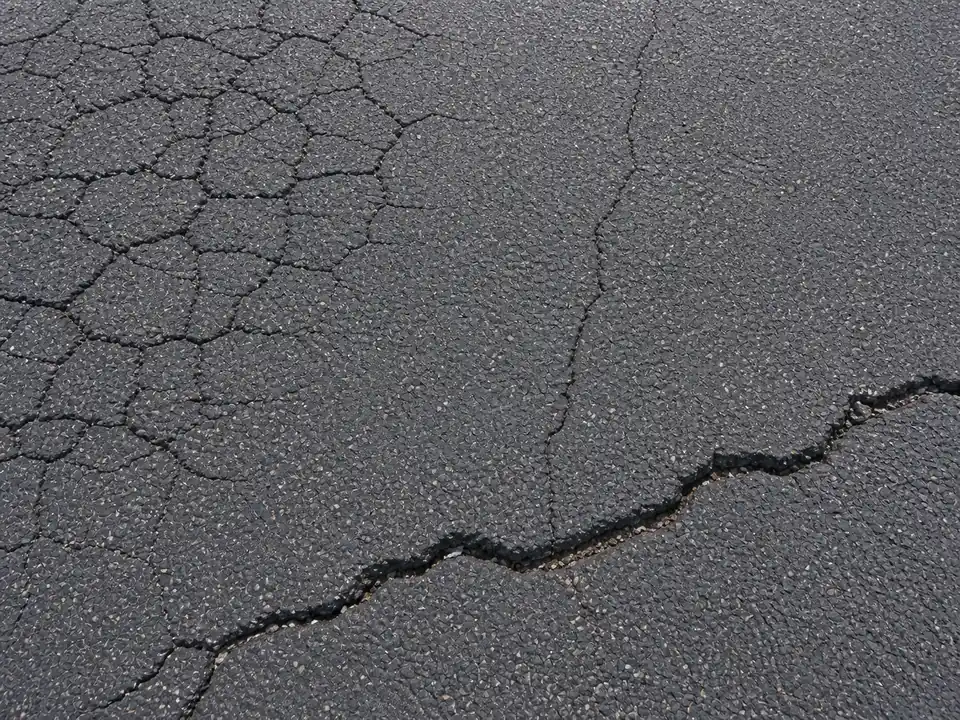
Most homeowners look at a crack and ask one question: how wide is it. Width matters, but the shape and location matter more. A web of cracks half an inch wide is far worse than a single straight crack an inch wide, because the web means the ground under your driveway has moved. Below are the seven patterns, sorted roughly from least serious to most serious, with the cause behind each one and whether you can fix it with a bottle of crack filler or need a crew. If you want to understand the root causes first, our guide on why driveways crack covers the freeze-thaw, drainage, and base issues that drive all seven types.
1. Hairline cracks (surface aging)
Thin lines, usually under one-eighth of an inch wide, scattered across the surface with no clear pattern. These are the earliest sign of an aging surface. The asphalt binder oxidizes and shrinks as it loses oils to sun and air, and the surface develops fine cracking. They are cosmetic at first but open the door to water.
- Cause: Oxidation, sun exposure, normal aging, and minor shrinkage.
- Severity: Low. The most common and least urgent type.
- Fix: Clean and apply pourable crack filler, then sealcoat. This is the textbook case where sealcoating is worth it as prevention.
2. Transverse cracks (across the driveway)
Single cracks that run roughly straight across the driveway, perpendicular to the direction you drive. They are caused by temperature swings. As asphalt cools and contracts in winter, tension builds until the surface splits across its width. Cold-climate driveways get these almost as a rule.
- Cause: Thermal contraction, freeze-thaw stress, and sometimes a reflective crack from a joint in the base.
- Severity: Low to moderate. Fillable as long as the edges are not crumbling.
- Fix: Clean, dry, and fill with rubberized crack sealant. See our crack sealing walkthrough for the exact steps.
3. Longitudinal cracks (along the driveway)
Cracks that run the same direction as traffic, often down the center or along a paving seam. They form from a poorly bonded joint between two passes of paving, from base settlement, or from the same thermal stress that causes transverse cracks. A straight longitudinal crack that follows an old seam usually traces a weak joint from the original install.
- Cause: Weak paving joint, base settlement, or thermal stress.
- Severity: Low to moderate. Watch for widening, which points to settlement.
- Fix: Crack fill if narrow. If it traces a bad seam from day one, it may be one of several bad-install problems worth documenting.
4. Edge cracks (within a foot of the edge)
Cracks that run parallel to and within about 12 inches of the unsupported outer edge of the driveway. The edge has no lateral support, so it cracks and crumbles first. Poor drainage along the edge, lack of a compacted shoulder, and vehicles driving partly off the pavement all speed it up.
- Cause: Lack of edge support, poor drainage, and vehicles riding the edge.
- Severity: Moderate. It spreads inward if the edge keeps breaking away.
- Fix: Fill the crack, improve drainage, and add a compacted gravel or paver shoulder. Our edge crumbling fix covers rebuilding a failing edge.
5. Block cracking (large grid pattern)
A pattern of interconnected cracks that divide the surface into large rectangular blocks, often a foot or more across. Unlike alligator cracking, block cracking is not caused by traffic loads. It comes from the asphalt binder shrinking and hardening over years as it dries out. It is a sign the surface is old and brittle but the base may still be sound.
- Cause: Binder aging and shrinkage, daily temperature cycling over many years.
- Severity: Moderate. Widespread block cracking means the surface is near the end of its service life.
- Fix: Fill individual cracks, then sealcoat. If most of the surface is blocked, plan a resurface versus replace decision.
6. Slippage cracks (crescent shaped)
Half-moon or crescent shaped cracks, usually where vehicles brake, accelerate, or turn hard. They form when the top asphalt layer slides over the layer beneath it, often because of a poor bond between lifts or too much sand in the mix. The crack opens like a wrinkle pushed up by tire force.
- Cause: Weak bond between asphalt layers, bad mix, or a tack-coat failure during install.
- Severity: High. It is a structural surface defect, not a simple crack.
- Fix: Remove and replace the affected area. This is cut-out patch work, not crack filler. Compare it to other beyond-repair signs before deciding.
7. Alligator cracking (the serious one)
A dense web of interconnected cracks that looks like alligator or reptile skin, breaking the surface into many small pieces. This is fatigue cracking, and it means the structure under the asphalt has failed. The FHWA pavement program classifies it as load-related fatigue caused by a weak base, trapped water, or loads heavier than the driveway was built for.
- Cause: Base or subgrade failure, poor drainage, water intrusion, and repeated heavy loads.
- Severity: Highest. Surface filler is purely cosmetic and fails within a season.
- Fix: Cut out the failed area, repair the base, and repave. See the dedicated alligator cracking fix guide.
Quick crack diagnosis
Answer two questions and get a likely crack type plus the repair path. This is a starting point, not a structural inspection.
How to use the diagnosis once you have it
Once you know the type, the repair plan almost picks itself. The five linear and surface types (hairline, transverse, longitudinal, edge, and block) are crack-fill jobs you can usually do in an afternoon with a bottle or pail of rubberized filler, a wire brush, and a leaf blower. Clean the crack down to clean asphalt, remove any rooted weeds first, fill flush, and let it cure before you drive on it. Walking the driveway each spring to catch new cracks early is the cheapest maintenance there is; our spring inspection checklist turns it into a 15 minute routine.
The two structural types (slippage and alligator) are different animals. Filler on top hides them for a few weeks and then they reopen, because the problem is below the surface, not on it. The Asphalt Institute groups both under structural distress that calls for removal and replacement of the affected section, not surface treatment. If either covers more than a few square feet, get a contractor to assess the base before you spend a dollar on filler.
Why catching the type early saves money
Every crack is an entry point for water. Water reaches the base, freezes, expands, and lifts the asphalt, then the cycle repeats. A hairline crack ignored for two winters can widen into an edge or block pattern, and an untreated low spot that pools water can seed alligator cracking. The cost gap is large. Crack filler runs about 10 to 30 dollars for a season of work. A cut-out patch from a contractor runs a few hundred dollars. A full resurfacing or overlay runs into the thousands. Diagnosing correctly and filling the linear cracks while they are still linear is the highest-return maintenance you can do on a driveway.
Timing matters too. Fill cracks in dry, mild weather, ideally above 50 degrees Fahrenheit, so the filler cures and bonds. The EPA notes that managing stormwater runoff and keeping water from pooling on pavement extends its life, which is exactly what crack sealing and good drainage do for a driveway. If your driveway already shows several types at once, that is normal on an older surface; treat each by its own rule rather than reaching for one product for everything.
Bottom line
Diagnose asphalt driveway cracks by pattern first, width second. Hairline, transverse, longitudinal, edge, and block cracks are surface problems you can clean and fill yourself, then sealcoat to protect. Slippage and alligator cracking are structural failures that need cut-out repair or repaving. Catch them early, keep water out, and you turn a multi-thousand-dollar replacement into a 20 dollar afternoon. When you are ready to act, the calculators below help you size filler, plan a sealcoat, or budget a bigger fix.