To fix a crumbling asphalt driveway corner or apron, dig out the loose material, cut the edge back to solid asphalt, rebuild the base with compacted gravel, add edge support, then fill with cold patch in thin lifts and tamp each layer hard. Seal the seam to keep water out. See our asphalt repair overview for related fixes.
Why corners and aprons fail before the rest of the driveway
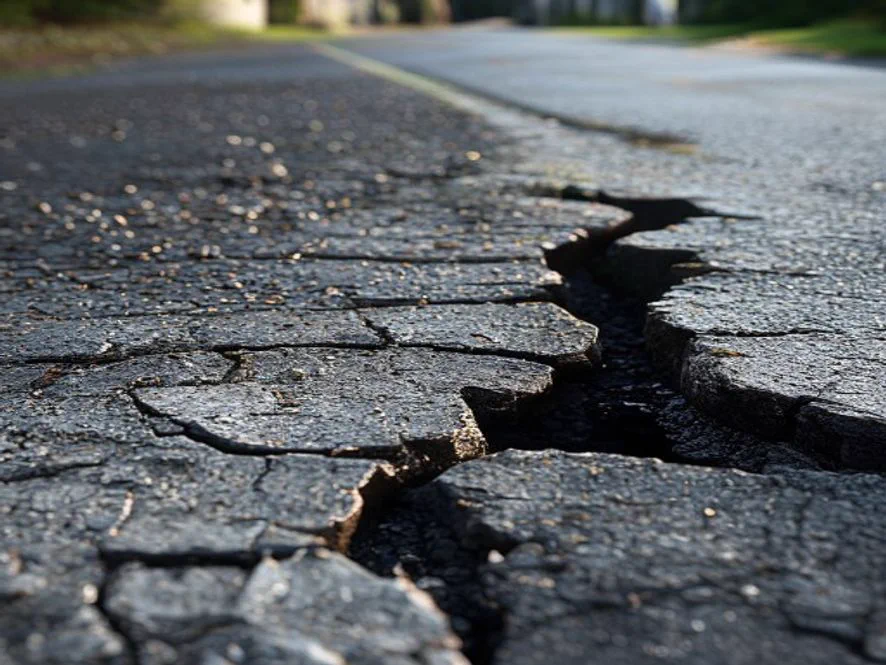
The middle of your driveway is confined on all sides, so it stays locked in place. Corners and the apron are different. They are unconfined edges. Nothing sits beside them to push back when a tire rolls over, so the asphalt flexes, cracks, and shears off in chunks. This is the same root cause behind a crumbling driveway edge, just concentrated at the most loaded spot.
Three things gang up on these areas. First, tire load lands right at the lip every time a car turns in or out. Second, water runs to the low outside edge, seeps under the unsupported asphalt, and washes the base away. Third, in cold regions freeze-thaw cycles expand that trapped water and pry the edge apart. The U.S. Federal Highway Administration documents how moisture in the base layer drives edge failure, and you can read more on pavement distress at fhwa.dot.gov. If your region freezes, our freeze-thaw damage guide explains the cycle in detail.
The base is also usually thinner at the edge than in the field of the driveway, especially on a bad install. If the corner started failing within a year or two, the build quality may be the real story. Compare what you see against the patterns in our bad install problems guide.
Apron versus corner: know what you are fixing
The terms get mixed up, so be clear before you start. The apron is the transition section where your driveway meets the street, curb, or public sidewalk. It often sits inside the public right of way, which the city owns. A corner is any outside edge of the driveway slab, usually where it meets grass or a flower bed. Both fail for the same unconfined-edge reason, but the apron may carry rules. Our apron explainer covers the boundary details.
- Corner damage: on your own property. Repair it whenever you like with no permit.
- Apron damage: may be in the right of way. Some cities require a permit and a licensed contractor to touch it.
- Curb tie-in: if the break runs into a concrete curb or gutter, the city almost always owns that piece. Call before you cut.
Permit rules vary widely by town. Before you repair an apron, check our notes on driveway permits and call your local public works office. A quick call beats a fine.
Tools and materials you need
This is a half-day job for one person with basic tools. You do not need a paving crew for a single corner.
- Cold patch asphalt: one to three 50-pound bags for a typical corner. It costs about 15 to 25 dollars a bag at a home center.
- Crushed gravel base: a half bag to one bag to rebuild any hollow under the missing asphalt.
- Edge restraint: a row of pavers, a poured concrete lip, or steel edging to confine the new patch.
- Compactor: a hand tamper for small jobs, or a rented plate compactor for about 60 to 90 dollars a day for a bigger apron.
- Cutting tools: a cold chisel and hammer, or an angle grinder with a masonry blade, to square the broken edge.
- Hand tools: a flat shovel, a stiff broom, gloves, and safety glasses.
Cold patch handles repairs you can do without heating equipment. If you want the difference between this and hot mix, our cold patch vs hot mix guide lays it out. For deep or large breaks, hot mix from a pro will outlast cold patch by years.
Step-by-step: rebuild the corner
Pick a dry day above 50 degrees Fahrenheit so the patch sets well. Work in this order.
- 1. Remove loose material. Pry and sweep out every loose chunk, dust, and crumbled asphalt until you hit solid edges and a firm base. Anything soft will come back later.
- 2. Square the edges. Cut the broken edge back to clean, vertical, solid asphalt with a chisel or grinder. A patch needs a real wall to bond to. Tapered, feathered edges peel.
- 3. Rebuild the base. Add crushed gravel into any hollow or washed-out area and compact it until it stops moving. A solid base is the whole job. Skip this and the patch sinks.
- 4. Add edge support. Set a paver row, a concrete edge, or compacted backfill against the open side so the new patch is confined. This is the step most people skip, and it is why their repair fails again.
- 5. Fill in lifts. Pour cold patch in layers no deeper than 2 inches, slightly overfilled, working from the bottom up.
- 6. Compact each layer. Tamp every lift hard until the surface is dense, level, and stops springing back. Compaction is what makes asphalt strong.
- 7. Cure and seal. Drive on it lightly over a few days to finish compaction, then seal the seam to lock out water.
If the break is mostly a crack feeding into the corner rather than a missing chunk, treat the crack too. Our crack sealing guide covers that, and our general crack repair guide helps you judge severity.
Estimator
Cold patch and cost estimator
Enter the rough size and depth of your broken corner to see how much cold patch and roughly what budget you need.
How much corner and apron repair costs
Costs depend on whether you do it yourself, hire a patch job, or replace the apron outright.
- DIY corner patch: about 30 to 120 dollars in cold patch, gravel, and edging.
- Pro small apron patch: roughly 200 to 600 dollars for a contractor to cut, base, and patch a section.
- Full apron replacement: about 600 to 1,800 dollars with hot mix, proper base work, and compaction.
If your whole driveway is showing edge breakup, settling, and cracking, patching corners one at a time may be throwing good money after bad. Use our repair, resurface, or replace guide and the honest checklist in when a driveway is beyond repair. To size a bigger job, run the numbers in our driveway cost calculator before you call anyone.
Stop the corner from breaking again
A patch that ignores the cause will fail the same way. The fix is to confine the edge so it stops behaving like a free-hanging lip.
- Build a border: a paver row or concrete edge beam gives the asphalt a wall to lean on. See paver border ideas.
- Backfill the side: bring soil or gravel up flush with the asphalt so no edge is exposed to open air.
- Fix drainage: keep water off the edge. Our drainage solutions show how to redirect runoff.
- Drive gently: do not crank the wheel while parked on the edge, and avoid riding the lip when turning in.
Sealing helps too. Once the patch cures, a yearly look at the edges catches small breaks before they spread. Our maintenance schedule keeps you on track. For material standards behind a durable repair, the National Asphalt Pavement Association at asphaltpavement.org is a solid reference, and general pavement care guidance is available from epa.gov on stormwater and surfaces.
When to call a pro
DIY is fine for a clean corner under about 4 inches deep with a stable base. Call a contractor when the break is deeper than 4 inches, when the base under it has washed out badly, when the damage spans more than a few feet of apron, or when the apron sits in the public right of way and needs a permit. If you do hire out, vet the company with our contractor selection guide first.
Bottom line
Corner and apron damage is almost always an edge-support problem, not just a surface problem. Clean it out, square the edge, rebuild the base, confine the side, and fill in compacted lifts. A careful DIY corner patch costs under 120 dollars and lasts years if you add edge support and keep water away. Skip the support and you will be patching the same spot next spring.