A paver or brick border frames an asphalt driveway with a strip of clay brick, concrete paver, or granite cobble set along each edge. It sharpens the look, stops the edges from crumbling under tire loads, and adds lasting value. Most borders cost 8 to 25 dollars per linear foot installed.
Why add a border to an asphalt driveway?
Asphalt has one real weakness at the edges. The mix has no curb or form holding the outer few inches, so over time the sides slump, ravel, and break off where tires ride close to the edge. A solid border solves both the looks and the structure at once.
- Edge support. A paver course set on a firm base gives the hot mix something to lean against, which is the same reason proper base prep matters under the whole driveway.
- Curb appeal. A crisp light-colored band against black asphalt reads as finished and intentional. It is one of the cheapest ways to lift the look of a plain driveway.
- Defined edges. The border tells drivers where the pavement ends, which protects your lawn and reduces ruts in soft soil.
- Home value. Clean hardscape detail helps at resale and supports the broader return a driveway adds to home value.
The National Asphalt Pavement Association notes that unsupported edges are a common failure point on residential drives, which you can read more about at asphaltpavement.org.
What materials work best for the border?
Four materials cover almost every driveway border. Each trades cost against durability and looks.
- Clay brick. The classic choice. A single soldier course (bricks stood on end) gives a warm red band for roughly 8 to 14 dollars per linear foot. Use true paving brick, not soft wall brick, so it survives freeze-thaw.
- Concrete pavers. The most flexible for color and shape. Holland, cobble, and tumbled styles all work. Expect 10 to 18 dollars per linear foot. Pick a paver rated for vehicular traffic.
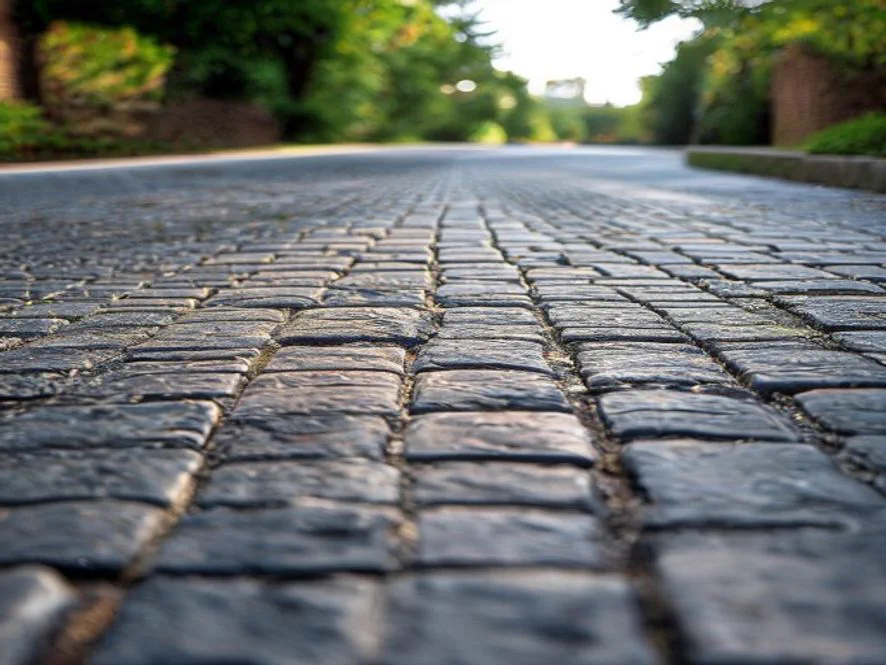
- Belgian block and granite cobble. The toughest and most expensive, often 18 to 25 dollars or more per linear foot. Stone shrugs off plow blades and tire scrub and looks great for decades.
- Cobble-look concrete. A budget stand-in for granite. Lower cost, but check the freeze-thaw rating in cold regions.
For very cold climates, follow the freeze-thaw guidance for hardscape at the Federal Highway Administration site, fhwa.dot.gov, and choose a dense, low-absorption unit.
Popular border layouts and design ideas
The layout sets the personality of the driveway. These patterns all read well against asphalt.
- Single soldier course. One row of brick or block on edge. Simple, clean, and the lowest cost. This is the most common choice.
- Double-wide band. Two courses, often a row laid flat with a soldier course on the outside. Adds weight and a more formal frame.
- Contrasting color. Charcoal pavers next to black asphalt read subtle and modern. Tan or red brick reads traditional. A light band stands out the most.
- Ribbon and apron accents. Carry the border across the driveway apron at the street for a stronger entry, or wrap a turnaround to define the parking zone.
- Curved edges. Pavers follow gentle curves better than a poured curb, so a flared entry looks crisp.
If you are weighing a full paver surface against asphalt with a paver trim, the cost gap is large. Compare the two in our asphalt vs paver cost guide before you decide.
How is a paver border installed?
The method depends on whether the asphalt is already down. Both share the same goal: a stable base and a clean, flush joint with the pavement.
- Excavate. Dig a trench along the edge, usually 6 to 10 inches deep and a few inches wider than the pavers.
- Build the base. Add 4 to 6 inches of compacted crushed stone. For heavy use or freeze-thaw zones, pour a thin concrete footing so the units cannot shift.
- Set the units. Bed the brick or block on a sand or mortar layer. Keep the top flush with or just below the asphalt so a plow blade glides over it.
- Lock the edge. Haunch the back of the border with concrete or use edge restraint spikes so tires and frost cannot push it outward.
- Joint and seal. Fill joints with polymeric sand or mortar. Sweep, mist, and let it cure.
When adding a border to an existing driveway, the crew saw-cuts a straight edge first, then beds the pavers tight against it. A ragged edge needs trimming so the new joint stays narrow. If the existing edge is already failing, fix that first using our edge crumbling repair steps.
Estimator
Border Cost Estimator
Enter your driveway perimeter and a price per linear foot to size the job. One long edge plus the other long edge plus the entry equals your border length.
How much does a border add to the project?
Border cost depends on material, base type, and length. A simple brick soldier course on a stone base runs near the low end. Granite cobble on a concrete footing runs near the high end. A typical 180 to 220 foot perimeter lands between 1,600 and 5,000 dollars installed.
- Material. Clay brick and concrete pavers cost less than granite block.
- Base. A compacted stone base costs less than a poured concrete footing, but the footing lasts longer in freeze-thaw areas.
- Access and curves. Tight curves and cutting fees add labor.
To fold the border into your whole-project budget, run the numbers through our driveway cost calculator, then size the asphalt itself with the asphalt calculator. If a contractor bundles the border into a paving quote, sanity-check the total with the quote checker.
How do borders compare to other edging?
Paver and brick borders are not the only way to define an edge, but they last the longest.
- Plastic or aluminum edging. Cheap and fast, but it heaves with frost and looks thin. Better for garden beds than driveways.
- Poured concrete curb. Strong and clean, but it cannot follow tight curves as gracefully and can crack at control joints.
- No border. Lowest cost up front, but the asphalt edge needs more upkeep. See the wider menu of driveway edging ideas to compare.
If curb appeal is the main goal, pair the border with the other quick wins in our curb appeal guide and landscaping ideas.
Bottom line
A paver or brick border is one of the best value upgrades for an asphalt driveway. It protects the weak edges, follows curves a poured curb cannot, and frames the black surface so the whole drive looks finished. Budget 8 to 25 dollars per linear foot, set the units flush and on a firm base, and the border will outlast the asphalt itself.