Freeze-thaw damage is cracking caused by water that soaks into asphalt, freezes, and expands about 9 percent in volume. Each freeze pries the opening wider; each thaw lets more water seep deeper. Over 30 to 80 cycles a winter, hairline cracks grow into wide cracks and potholes. Sealing keeps the water out. See why driveways crack for the full picture.
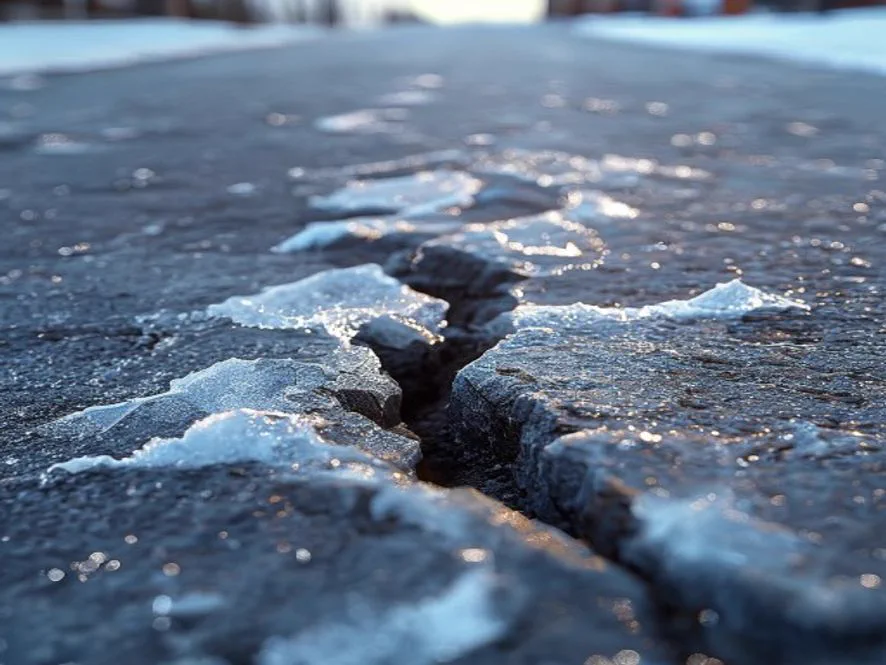
The mechanism, step by step
Asphalt is not solid. The surface is full of tiny pores, and the moment a first hairline crack appears it gives water a direct path inside. Freeze-thaw damage is the same physics that splits boulders and buckles roads, scaled to your driveway. Here is the chain of events.
- Water enters. Rain, snowmelt, or salt-melted ice seeps into surface pores and any crack. A driveway with worn sealcoat absorbs water like a dry sponge.
- Temperature drops below 32 degrees Fahrenheit. The trapped water freezes and expands about 9 percent. That expansion has nowhere to go, so it pushes outward against the asphalt walls of the crack or pore.
- The opening widens. Ice acts like a slow wedge. A single freeze moves the crack only a fraction of a millimeter, but the change is permanent.
- It thaws. The ice melts, the crack stays its new wider size, and now even more water can fit inside for the next round.
- Repeat. Multiply by dozens of cycles a season and a hairline crack becomes a quarter inch, then a half inch, then a network.
The reason ice is so destructive is that water is one of the few substances that expands when it freezes. The force generated when confined water turns to ice is enormous, easily more than asphalt binder can resist. The Federal Highway Administration names freeze-thaw as the leading pavement failure mode in northern states for exactly this reason.
How many freeze-thaw cycles does a winter bring?
A cycle is counted every time the pavement surface crosses 32 degrees Fahrenheit downward and then back up. The count matters more than how cold it gets, because each crossing is one wedge action.
- Deep-cold regions (upper Midwest, northern New England): roughly 30 to 50 cycles. Temperatures often stay below freezing for weeks, so the surface does not thaw and refreeze as often.
- Transition climates (mid-Atlantic, Ohio Valley, mountain West): 60 to 100 cycles. Daytime sun melts, night refreezes. These swing-across-32 climates are the worst for freeze-thaw despite milder averages.
- Mild South: 5 to 20 cycles. Damage is real but slow.
This is why a driveway in Virginia can crack faster than one in Minnesota. The Minnesota slab spends January frozen solid and still; the Virginia slab thaws and refreezes nearly every day. Climate drives the math, and our guide to how weather affects driveway lifespan goes deeper on regional differences.
Freeze-Thaw Cycle Estimator
Enter your typical winter and see roughly how many freeze-thaw cycles your driveway endures, plus how a crack can grow if left open.
Estimate only. Crack growth assumes the crack stays unsealed. Sealing stops the growth.
Why salt and water make it worse
Salt does not chemically attack asphalt the way it attacks concrete. The harm is indirect but real. Deicers turn ice into liquid water on a surface that may refreeze hours later. That extra meltwater wicks into pores and cracks, so heavy salting effectively raises the number of melt-and-refreeze events your pavement lives through. More cycles, more wedging. If you deice, a gentler product means less liquid sitting in the cracks. Our breakdown of whether salt damages asphalt and the best ice melt for asphalt covers which products to choose.
Drainage is the other half. Standing water that freezes in a low spot drives concentrated damage. Fixing the grade so water runs off matters as much as sealing. See driveway drainage solutions if you have a birdbath or a section that ponds.
Where freeze-thaw damage shows up first
- Edges. The perimeter has no lateral support and often sits over a thinner base. Water pools there and ice pushes outward into open air. This is why crumbling usually starts at the edge.
- Existing cracks. Any opening is a water reservoir. Last year's hairline is this year's quarter-inch gap.
- Low spots and seams. Where water collects or where two paving passes meet, freeze-thaw concentrates.
- North-facing slopes. Less sun means slower drying and more time with water sitting in the surface.
Once water reaches the gravel base and freezes there, you get frost heave, where the ground itself lifts the pavement. That is a deeper problem covered in frost heave repair. The progression from surface cracking to base failure is also why spring is pothole season, and why the base and drainage choices made when installing asphalt in cold climates do so much to resist freeze-thaw in the first place.
How to stop freeze-thaw damage
You cannot stop winter, but you can cut off the water that does the damage. Every fix below works by keeping liquid out of the pavement before it can freeze.
- Seal cracks before fall. The single highest-leverage task. A filled crack holds no water. Read how to seal cracks.
- Sealcoat on schedule. A sound surface coat closes the pores so water cannot wick in. Every 2 to 4 years for most driveways.
- Fix drainage. Eliminate ponding so there is nothing to freeze in a low spot.
- Deice gently and clear snow. Less standing meltwater means fewer effective cycles. Plowing with a rubber edge avoids gouging that opens new water paths.
- Catch it early. A crack under a quarter inch costs a few dollars of filler. The same crack ignored for two winters becomes a pothole repair. Read why driveways crack for the early signs.
What it costs if you ignore it
Freeze-thaw damage is cheap to prevent and expensive to repair. A bottle of crack filler runs 10 to 25 dollars. A full sealcoat runs a few hundred. But a winter of unsealed cracking can turn into a resurfacing job at several thousand dollars, or a full replacement if the base fails. The economics overwhelmingly favor sealing early. Plan the numbers with the asphalt sealer calculator or the driveway cost calculator if damage has gone far enough to consider resurfacing.
Bottom line
Freeze-thaw damage is one simple loop. Water gets in, freezes, expands, and widens the opening, then more water gets in next time. The cracks you see in spring are the receipt for every cycle the driveway went through. The whole defense is keeping water out: seal cracks before fall, sealcoat on schedule, fix drainage, and catch small cracks while they are still small. References for the freeze-thaw chemistry and cycle data are on the sources page.