If tree roots are lifting your asphalt driveway, the lasting fix is to deal with the root first, then the pavement. Cut out the heaved section, sever or grind the offending root, add a root barrier or remove the tree, then patch with hot mix. Patching alone fails because the live root keeps growing. Confirm the cause with our why is my driveway cracking guide.
Why do tree roots lift asphalt?
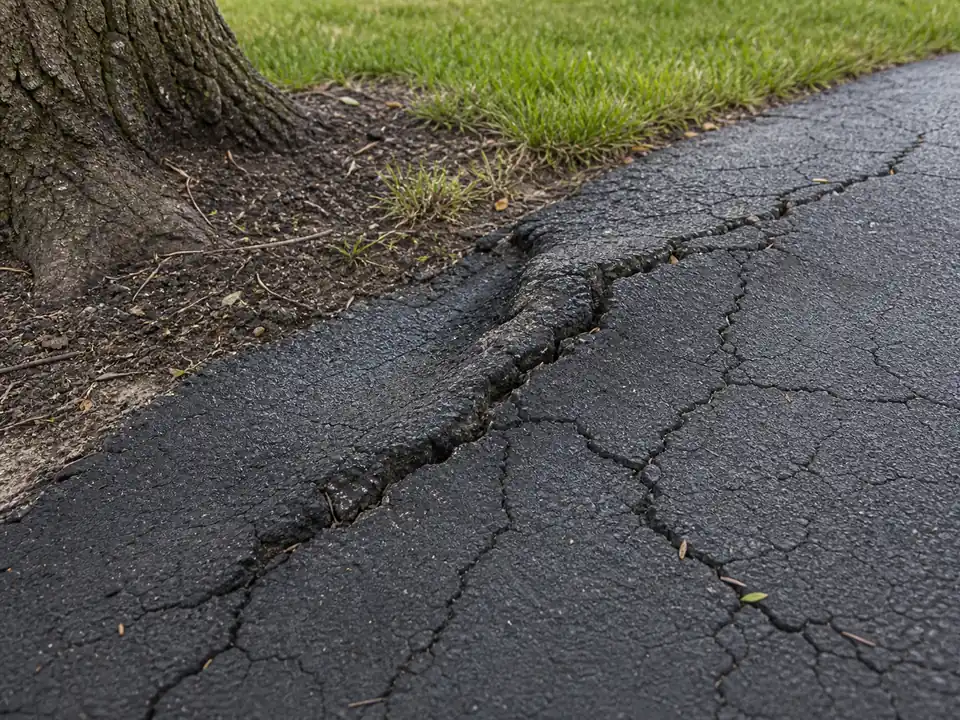
Roots do not punch up through asphalt on purpose. They grow outward in the top 6 to 24 inches of soil looking for water and air, and that is exactly where your driveway base sits. As a root thickens year after year, it expands like a slow wedge. Asphalt is flexible but not that flexible, so the surface bulges, cracks, and finally heaves into a ridge.
Three things make it worse. Shallow-rooting species such as silver maple, willow, poplar, sweetgum, and many elms send aggressive surface roots straight toward the nearest moisture. A tree planted too close to the edge, generally within 10 to 15 feet, puts major roots right under the pavement. And a thin or poorly compacted base gives roots an easy path; a properly built base resists them longer. You can read more about how the layers under your driveway are supposed to work in our asphalt driveway layers explained guide.
The U.S. Forest Service, part of federal infrastructure research, notes that hardscape conflicts almost always come from a handful of fast, shallow species planted too close to paving. Species choice and distance matter more than soil type.
How do I know roots are the cause and not frost or base failure?
Several problems look alike from the driver's seat. Sort them out before you spend money.
- Roots: The heave is a long ridge or dome, usually pointing back toward a nearby tree like a finger. Cracks radiate off the high point. The lift gets a little worse every growing season, not overnight.
- Frost heave: The lift appears in winter, sits over wet or poorly drained soil, and often settles back in spring. See our frost heave fix guide to tell them apart.
- Settling, not lifting: If the spot is sinking instead of rising, the base washed out or was never compacted. That is covered in asphalt driveway settling fix.
- General base failure: Alligator cracking with no nearby tree usually means a weak base, covered in alligator cracking fix.
The simple test: stand on the high point and look at where the ridge points. If it lines up with a tree trunk and the trunk is within about 20 feet, roots are almost certainly the cause.
Can I cut the root and just patch it?
Sometimes, but only when the math works in your favor. Cutting a root that caused a heave can save the driveway, but cutting the wrong root can kill the tree or make it a fall hazard. A common arborist rule of thumb is to never cut a root closer to the trunk than three to five times the trunk diameter. A 12-inch trunk means staying at least 3 to 5 feet out from the base.
If the offending root is small (under about 2 inches) and well out from the trunk, severing it and grinding the stub is reasonable DIY-adjacent work. If it is a large structural root, or close to the trunk, stop and call a certified arborist. The tree's stability is worth more than the patch.
- Expose the root: Cut out the heaved asphalt with a saw, then dig down to find the root with a shovel and hand tools, not a machine that can gouge it.
- Sever cleanly: Use a pruning saw or reciprocating saw for a clean cut. Ragged tears invite rot and disease.
- Grind or remove the stub: Pull the cut section out of the patch footprint so it cannot keep pressing on the new asphalt.
- Block regrowth: Drop in a root barrier before you close the patch, or the same root regrows in 2 to 4 years.
What is a root barrier and when does it work?
A root barrier is a rigid panel, usually HDPE plastic or sometimes metal, buried vertically in the soil between the tree and the driveway. It does not kill roots. It redirects them downward and away so they grow under the slab instead of lifting it. Typical depth is 18 to 36 inches; deeper is better in loose soil.
Barriers work best as prevention or right after a single root removal. They are far less effective once a tree has many large roots already established under the pavement, because you cannot install a continuous barrier without trenching through those roots. For a young tree near a planned driveway, a barrier installed at planting is the cheapest insurance you will ever buy.
When does the tree have to come out?
Removing a mature shade tree is a real loss in shade, privacy, and home value, so it is the last resort. But there are cases where it is the only fix that lasts.
- The trunk is within a few feet of the heave. You cannot cut roots that close without destabilizing the tree, and a barrier will not fit.
- Multiple large roots run under the driveway. Cutting enough of them to save the pavement would kill or topple the tree anyway.
- The damage keeps returning after patch and barrier attempts, season after season.
- The tree is also damaging the foundation, sewer line, or a retaining wall. At that point the tree is the problem, not just the symptom.
If you are selling soon, weigh this against curb appeal; our repair or replace before selling guide covers that trade-off. The EPA's guidance on trees and stormwater is worth a read before you remove a mature canopy, since trees also manage runoff that would otherwise hit your driveway.
Root damage decision helper
Answer four questions to see whether you can patch, barrier, or need the tree removed, plus a rough cost.
How do I repair the heaved section the right way?
Once the root is dealt with, the asphalt repair is a standard cut-out patch. The steps:
- Mark and saw-cut a clean rectangle around the heaved area, a foot past the damage on all sides into sound pavement.
- Remove the failed asphalt and base, then pull out the cut root section so nothing presses on the new patch.
- Install the root barrier vertically along the tree side of the hole, 18 to 36 inches deep.
- Rebuild the base with crushed aggregate, compacted in 2 to 4 inch lifts. A solid base is everything; see the base prep guide.
- Pave with hot mix for a lasting patch, or cold patch for a small DIY fix, compacted flush with the surrounding surface.
- Seal the seams with crack filler once cured, then sealcoat on your normal schedule.
If the lift is small and the surface around it is otherwise sound, this localized patch is the move. If roots have damaged a wide area, you may be better off resurfacing or replacing; weigh that with our resurface vs replace comparison. To size materials and budget, run the numbers through the asphalt calculator and the driveway cost calculator.
What does the whole job cost?
Costs vary by region and tree size, but here are realistic 2026 planning ranges. Treat them as ballparks, not quotes.
- Small cut-out patch with root removal: 300 to 800 dollars.
- Root barrier install: 200 to 600 dollars added.
- Tree removal: 500 to 2,000 dollars or more for a large tree, stump grinding extra.
- Larger area resurface or replace: several thousand dollars, depending on square footage.
Before you pay any contractor, sanity-check the bid against the quote checker so you are not overpaying for a small patch. The figures above and our other cost pages are backed by the references on our sources page.
How do I stop it from happening again?
Prevention is cheaper than any repair. If you are planting near a future or existing driveway, choose deep-rooting, slower species and keep them at least 15 to 20 feet from the pavement edge. Install a root barrier at planting time. For existing trees, an arborist can root-prune on a schedule before roots get big enough to heave. Keep the driveway base in good shape and drainage working; standing water draws roots, so fixing standing water issues helps. The EPA and your local extension office both publish species lists for hardscape-friendly planting.
Bottom line
Tree roots lifting asphalt is a root problem first and a pavement problem second. Patching the surface without addressing the live root just resets the clock. Identify the root, decide whether you can cut it safely or need an arborist, block regrowth with a barrier or remove the tree, then repair with a clean cut-out patch over a solid base. Match the repair to the size of the damage and confirm the price before you sign.