You just rolled out a fresh coat of driveway sealer. Now you need to know when you can walk on it, when the cars can come back, and when life returns to normal. The short answer is hours for foot traffic, a day or two for vehicles, and a full month for total cure. The longer answer depends on weather and how much sealer you laid down. Plan your timing alongside the sealcoat schedule guide and size the order with the sealer calculator.
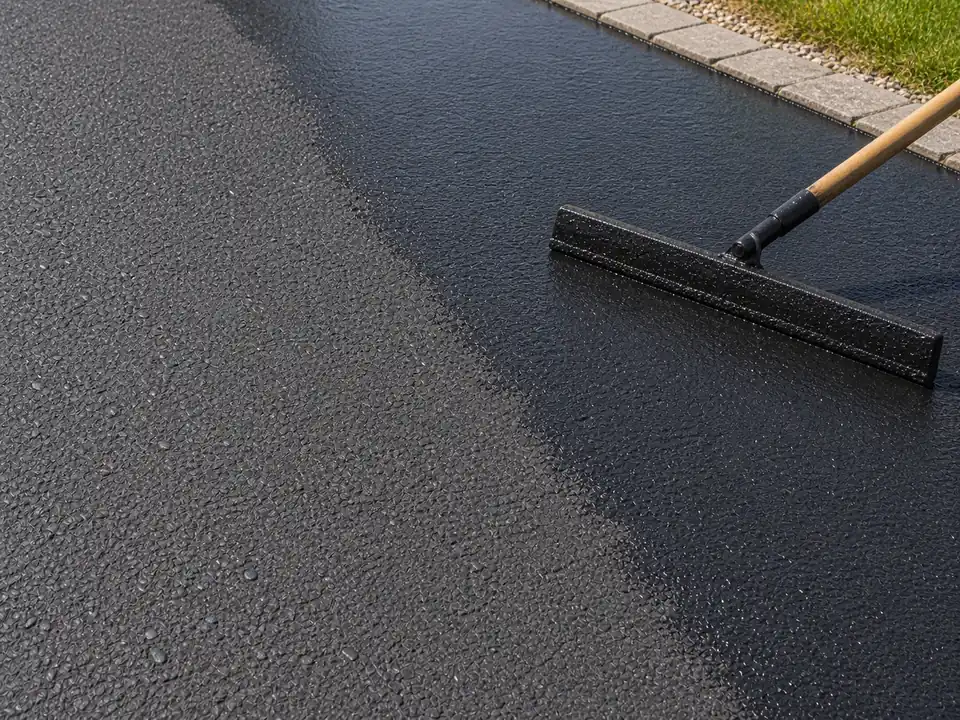
The three dry-time milestones
Sealcoat does not have one drying number. It has three.
- Dry to touch: 1 to 2 hours. Surface is no longer wet but is not yet walkable.
- Foot traffic safe: 4 to 8 hours. Light walking with clean shoes.
- Vehicle traffic safe: 24 to 48 hours. Slow, straight-line driving only for the first day.
- Full cure: 30 days. The chemistry finishes hardening.
Each milestone has a baseline. Each baseline shifts based on weather.
What slows it down
Three conditions stretch the wait.
- High humidity. Above 65 percent, water cannot evaporate fast enough. Add 2 to 4 hours per milestone.
- Cool nights. Pavement under 60 degrees Fahrenheit at sundown slows cure for the whole evening. Plan around it.
- Shade. Tree-covered driveways dry 30 to 50 percent slower than full-sun driveways.
- Thick or second-coat application. A second coat applied the same day doubles the foot-traffic wait.
What speeds it up
Three conditions shrink the wait.
- Direct sun. Pavement heats fast. Surface moisture flashes off.
- Low humidity. Below 40 percent, the cure runs near best case.
- Warm pavement. A pre-heated driveway from a sunny morning seals and dries faster than a cold slab.
Dry time estimator
Enter today's conditions. The calculator returns when foot traffic, vehicles, and full cure are safe.
Done by (clock time): tomorrow morning
Why the manufacturer's 4 hour claim is misleading
The label on the pail says 4 hours to dry. That number is real. It is also a lab number. It assumes 70 degrees Fahrenheit, 50 percent humidity, direct sun, and a thin single coat. Real driveways are rarely all four at the same time. Treat the label time as a floor. Add 2 hours for shade. Add 2 hours for humidity above 65 percent. Add 4 hours for a second coat. The DIY mistakes guide has more on what trips people up.
Foot, vehicle, and heavy use
Each load type has its own threshold.
- Foot traffic. 4 to 8 hours. Walk lightly. Avoid pivoting and dragging anything.
- Light vehicles. 24 to 48 hours. Drive slow and straight. No hard turns. No braking on the slab.
- Heavy vehicles. 72 hours. RVs, trailers, work trucks. Static load can imprint a still-soft surface.
- Basketball hoops, planters, trash cans. 7 days. Sharp-edged static loads leave marks in the first week.
Sprinkler and rain rules
Keep sprinklers off the driveway for 24 hours. Light rain in the first 4 hours strips the sealer in streaks and forces a recoat. Light rain between 4 and 24 hours dulls the finish but the sealer mostly holds. Rain after 24 hours is fine. Emulsion sealers actually benefit from a misting after 48 hours because it speeds the chemical bond. The new asphalt timing guide covers when to schedule around forecasts.
Full cure and the 30 day edge rule
Even after the surface walks and drives like normal, the sealer keeps hardening. Inside a month it reaches full chemical cure. During that month, treat the edges with care. Sharp turns near the edge can break the lip. Heavy point loads near the edge can crack the lip. Keep car wheels off the outer 6 inches for the first week. The lifespan guide explains why edges are the first part to fail.
How a second coat changes the math
A second coat doubles the foot-traffic wait. The first coat needs 4 to 8 hours before the second goes on. The second coat then needs its own 4 to 8 hours. Plan for the full day. Vehicle traffic should wait 36 to 48 hours after the second coat. Use the sealer calculator to confirm gallon count before mixing a second batch.
A worked timing example
A homeowner in Ohio applies a single emulsion sealcoat on a Saturday morning at 9 AM. Temperature 78. Humidity 60 percent. Direct sun. Calculator says foot traffic at 4 hours, cars at 30 hours. Realistic schedule.
- 9 AM Saturday. Application starts.
- 1 PM Saturday. Foot traffic safe. Place cones. Walk lightly.
- 3 PM Sunday. Cars allowed back. Drive slow and straight.
- The following Sunday. Basketball hoop, planters, and trash cans can return.
- One month later. Full cure. Sealer is at design hardness.
Bottom line
Foot traffic in 4 to 8 hours. Cars in 24 to 48. Full cure in 30 days. Warm sunny low-humidity days hit the fast end of every range. Cool humid shaded days hit the slow end. Plan around a 24 hour window for vehicles and keep static loads off for a week. For the cost side of the project see sealcoating cost in 2026 and is sealcoating worth it.
Manufacturer and chemistry references are on the sources page. The Asphalt Institute publishes cure data on common sealer formulations. The NAPA maintenance library covers application standards.