"How long does an asphalt driveway last?" is one of the most common homeowner questions. The honest answer is "it depends." But the variables are knowable. This guide puts a realistic range on it, then explains which factors push you to the high or low end of that range.
The realistic range
A typical residential asphalt driveway lasts 15 to 25 years with proper installation and routine maintenance. The variables that move you within that range are predictable.
- Low end (8 to 15 years): Thin section over weak base, no drainage plan, ignored cracks, no sealcoat, freeze-thaw climate, heavy vehicle loading.
- Middle (15 to 20 years): Standard residential install, occasional sealcoat, basic crack repair, normal car traffic.
- High end (20 to 25 years): Solid base, good drainage, regular sealcoat schedule, prompt crack repair, mild climate, light traffic.
The National Asphalt Pavement Association publishes the field data behind these ranges, and the Asphalt Institute tracks the failure modes that pull the low end lower.
What shortens lifespan most
To predict whether a driveway will hit 25 years or fail in 10, look at these factors in priority order.
- Base prep. The base does the structural work. Asphalt thickness mostly spreads the load. A 4 inch driveway over a 6 inch crushed-stone base outlasts a 6 inch driveway over a 2 inch base, by years. See the driveway thickness guide for compacted depth targets.
- Drainage. Standing water is the biggest enemy. Pooled water freezes and thaws, gets under edges, and saturates the base. A driveway with proper grade and drainage outlasts a flat one by 5 to 10 years.
- Climate. Freeze-thaw cycles stress every joint and crack. Hot UV oxidizes the binder. Coastal salt air accelerates oxidation. The National Weather Service climate normals will show how many freeze-thaw cycles your area runs in a typical year, which is the single best predictor of cold-climate lifespan.
- Traffic and loads. Heavy trucks, RV jacks, and trailer tongues concentrate point loads on a thin section. Deep enough cure time matters too, especially in the first weeks.
- Maintenance. A one hour crack-fill afternoon every spring extends life. A skipped year compounds. See how to fix cracks and our 5-year maintenance schedule.
The warning signs you are nearing the end
Driveways do not fail suddenly. They tell you. The signs progress in roughly this order.
- Surface fading. Black goes gray. Cosmetic only, no structural meaning.
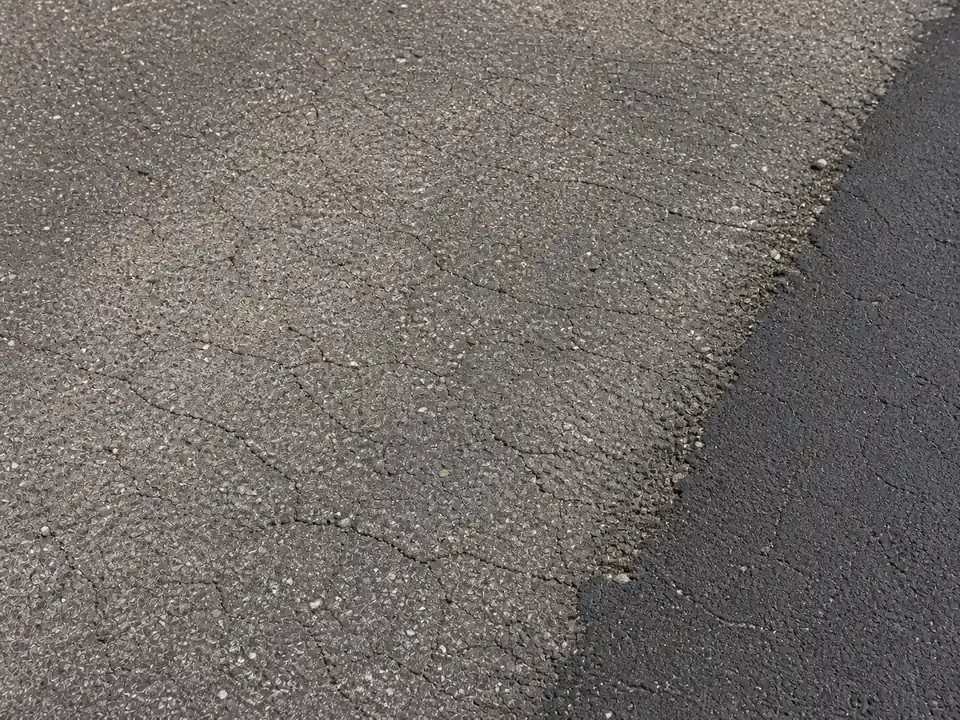
- Hairline cracking. First sign of binder oxidation. Easily filled.
- Wider cracks, edge crumbling. Movement stress. Still patchable with the right product.
- Standing water or pumping under load. Drainage or base problem. Investigate before paving over.
- Alligator cracking. Base failure showing through. Patching is cosmetic. Cut-out repair or replacement needed.
- Recurring potholes. The same holes keep reopening. The base is gone in those spots.
- Settled or pumping sections. The driveway is moving under traffic. Replacement time.
If your driveway shows only the first three signs, you have years left with maintenance. If it shows the last three, you are usually past patching. At that point, weigh overlay vs tear-out and price the project with the asphalt driveway cost calculator.
How to read your own driveway's age
If you do not know when your driveway was installed, look at four things. The surface color. The crack pattern. The edges. And how it drains after rain. A driveway with mostly hairline cracks, intact edges, and water that runs off cleanly is mid-life. It probably has 10 years or more left with maintenance. A driveway with alligator cracking, broken edges, and standing water is near replacement, regardless of its stamped age. If you are sizing up a property you do not own yet, the same four checks are the core of inspecting an asphalt driveway before buying a home, where a worn-out surface is a real bargaining point.
How to extend the life you have
- Sealcoat on a 2 to 4 year cycle, not annually. Use the when to sealcoat rule. Plan gallons with the sealer calculator.
- Fill cracks every spring. One hour, ten dollars in materials, years of life back.
- Clean oil stains promptly. Petroleum solvents soften the binder. The oil stain guide covers the right method.
- Fix drainage before it fixes you. A small re-grade is cheap. A failed base is not.
- Use a plastic shovel in winter. Metal blades chip the surface. Calcium chloride is gentler than rock salt.
Common lifespan myths
- "Sealing every year doubles the life." It does not. Excess sealer dries unevenly, cracks on its own, and traps moisture. The regrets thread distillation documents this in detail.
- "Thicker asphalt always lasts longer." Only if the base under it is solid. Thin asphalt over a strong base outperforms thick asphalt over a weak one.
- "Cracks are normal at 5 years." Hairline cracks, yes. Alligator or pumping at 5 years means installation cut a corner.
Sources, formulas, and the field references behind the lifespan ranges live on the sources page.