Before paving day, confirm the scope in writing, arrange parking off the driveway for several days, flag every sprinkler head and buried line, trim branches to 14 feet, and move all vehicles the night before. These five steps keep the crew on time and prevent costly surprises. See our paving day walkthrough and double-check quantities with the asphalt calculator.
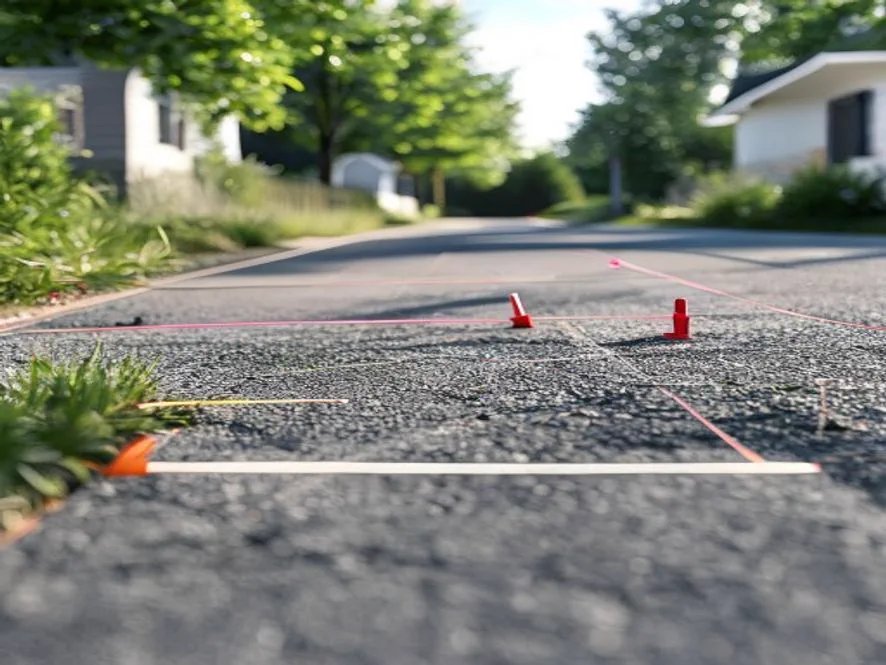
Why prep matters more than homeowners expect
Asphalt paving is a fast, time-sensitive job. Hot mix arrives in a truck at around 300 degrees Fahrenheit and has to be spread and compacted while it is still hot. Crews usually arrive between 7 a.m. and 8 a.m. and want to roll the surface within a tight window. Anything that blocks access, a parked car, a locked gate, a low branch, eats into that window and can turn into a return-trip fee or a canceled job.
Good prep also protects the things buried just under your yard. Pavers run heavy equipment over the edges of the work area, and a single crushed sprinkler head or drain line can cost hundreds to repair. The week before paving is the time to slow down, walk the site, and remove every obstacle. If you are still finalizing the install itself, our guides on base prep and residential thickness are worth a read so you know what the crew should be doing.
One week out: confirm the scope and the plan
Pull out your signed contract and read it again. You want zero surprises on the day the trucks show up. Confirm these details with your contractor by phone or email:
- Compacted thickness. Residential driveways are usually 2 to 3 inches of asphalt over a 4 to 8 inch stone base. Make sure the number on the contract matches what you discussed.
- Square footage and edges. Confirm where the new asphalt starts and stops, including the apron at the street. Use our tonnage calculator to sanity-check the tons of mix the job should need.
- Start time and crew size. Knowing when they arrive tells you when cars must be gone.
- Weather backup plan. Agree now on how a rain delay gets rescheduled so you are not scrambling.
- Payment terms. Re-read deposit and final-payment timing. If anything feels off, our paving contract checklist covers the clauses that protect you.
If you are not fully confident in the bid itself, run it through the quote checker before paving day so you are not arguing about price while a crew stands in your yard.
Two to three days out: clear the work zone
Now make the property physically ready. Walk the driveway and the path the trucks will use from the street.
- Trim overhead branches. Dump trucks and pavers need roughly 14 feet of vertical clearance. Cut back anything lower so equipment does not snag.
- Move objects off and beside the driveway. Basketball hoops, planters, trash bins, garden hoses, kids' toys, and parked trailers all need to go.
- Unlock gates and remove obstacles. If the crew needs to cross a gate or fence line, make sure it opens wide and stays open.
- Note drainage features. Point out where water currently runs. If you have a French drain or grade concern, flag it now, not after the asphalt is down.
Mark every sprinkler, line, and lid
This is the step homeowners skip and regret. Heavy rollers and trucks travel over the soft shoulders of the driveway, and they will crush anything shallow. Before the crew arrives, flag or spray-paint:
- Sprinkler heads and drip lines within a few feet of the edges.
- Septic lids, cleanouts, and tank access so nothing gets buried or driven over.
- Shallow utility lines for low-voltage lighting, invisible pet fences, and gas to a grill or fire pit.
- Drain inlets and downspout outlets that tie into the driveway.
For underground public utilities, call 811 at least a few business days ahead so power, gas, water, and telecom lines get located and marked for free. The Federal Highway Administration publishes background on how road and driveway surfaces are built if you want to understand what the crew is doing to your base.
The night before: move every vehicle
Crews often start at 7 a.m. A single car blocked in the garage can stop the whole job. The evening before paving:
- Move all cars to the street or a neighbor's driveway. Include the second car, the project truck, trailers, and the RV.
- Plan for several days of outside parking. You cannot drive on fresh asphalt for at least 24 to 72 hours, and heavy vehicles should wait longer. See our when can I park guide for the full timeline.
- Pull anything out of the garage you will need like the lawn mower, bikes, or a stroller, since you will not be able to roll them across wet asphalt.
Plan for pets, kids, and the cure window
Fresh asphalt is hot, soft, and gives off fumes for a day or two. Keep people and animals away from the hot mix during the work and off the new surface while it sets.
- Keep pets indoors or off-property during paving. Curious dogs and hot asphalt do not mix. Our note on pets and new asphalt covers the timeline.
- Barricade the driveway with cones, caution tape, or the crew's stakes so no one drives or walks on it before it is ready.
- Understand cure time. The surface hardens enough for foot traffic within a day, but full curing takes weeks. Read the curing time guide so you treat it gently the first season, and the first-year care guide for what comes after.
On fumes and outdoor air-quality basics, the EPA is a good neutral reference, and the CDC covers heat-related safety if you are outside watching the work on a hot day.
Quick tool
Paving day readiness check
Tick off each item, then see how ready you are. Nothing is stored or sent anywhere.
Cost context: what prep protects
A residential asphalt driveway commonly runs 7 to 13 dollars per square foot installed, which puts a typical job in the 3,000 to 7,000 dollar range and larger ones higher. A crushed sprinkler manifold, a return-trip fee, or a rushed pour on a wet base can quietly add hundreds. Solid prep is the cheapest insurance you can buy. To pin down your own number, run the driveway cost calculator and compare it against the 2026 average paving cost.
Bottom line
Prep is not complicated, but the timing matters. Confirm the scope a week out, clear the zone and flag buried fixtures a few days out, and move every vehicle the night before. Plan for pets, kids, and a multi-day cure window. Do that and your paving day runs smoothly, your yard stays intact, and your new driveway gets the clean, uninterrupted install it needs to last.