"Can I just pave this myself?" That is the most common DIY asphalt question on forums. The honest answer: parts of it, yes. The main paving lift, almost never. This guide splits the work that DIY-handles well from the work where DIY costs more than hiring a crew. If you are weighing the budget side, start with the asphalt driveway cost calculator and compare to a contractor quote.
What DIY actually saves money on
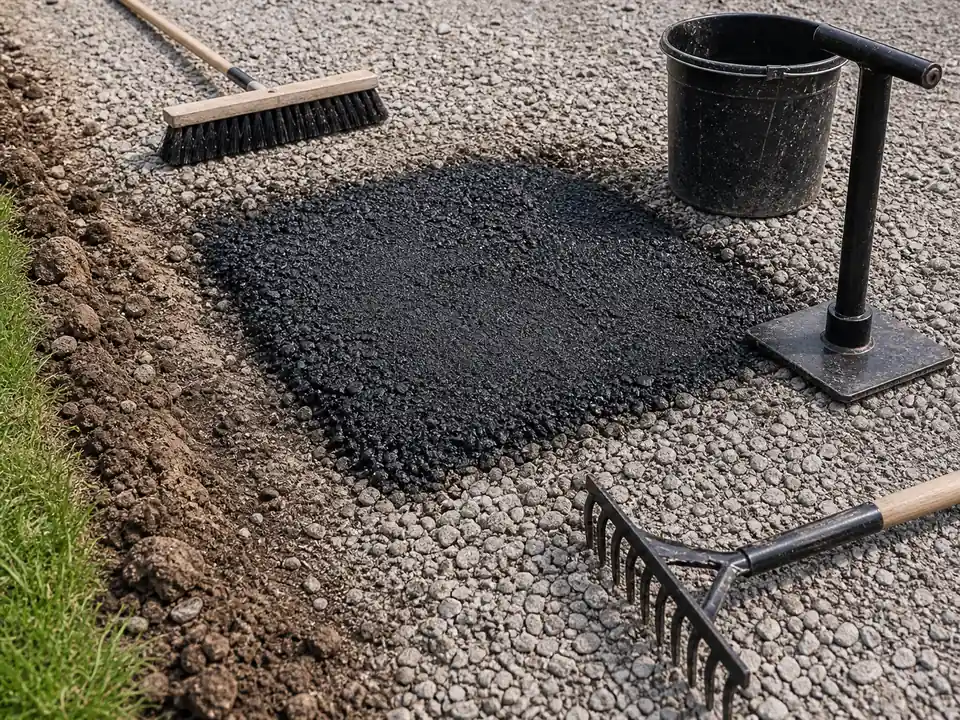
- Cold patch repair. Filling potholes and small failures with bagged cold patch is true homeowner work. A 50 lb bag costs 10 to 15 dollars. A homeowner with a tamper can fix a small pothole in 30 minutes. Read how to fix cracks in an asphalt driveway for the full repair-by-type breakdown.
- Crack filling. Pour-grade or bottle-grade crack filler is simple. Clean the crack, fill, smooth, let it cure. Done before sealcoat season, it can extend a driveway by years.
- Sealcoating a sound driveway. A clean, cured, mostly crack-free driveway can be sealed with a squeegee or roller. A 5 gallon pail covers about 250 to 400 square feet per coat. Two thin coats beat one heavy coat. Plan gallons with the asphalt sealer calculator, and time it with our when to sealcoat guide. The EPA has guidance on which sealer chemistries are restricted in your state, which is worth a 30-second check before you buy.
- Millings spread and roll. With a tractor and box blade or a skid steer with a roller, recycled asphalt millings can be DIY-installed on flatter driveways with prepared base. Estimate tons with the asphalt millings calculator and check slope limits first.
- Surface prep before any of the above. Power-washing, sweeping, oil-stain treatment, and edge cleanup are all manual labor that a contractor bills at full rate. Our oil stain removal guide covers the prep side.
What DIY almost never works on
- A new hot mix asphalt driveway. Hot mix arrives at 250 to 300 degrees Fahrenheit. It has to be placed, smoothed, and rolled in a narrow temperature window. Without a paver, a real roller, and a crew, you cannot get a driveway-quality finish from hot mix. By the time it cools enough to hand-place, it stops bonding. The National Asphalt Pavement Association publishes the placement and compaction specs that pros work to. The failure modes that follow a botched hand-placed pour show up in our problems from a bad asphalt install guide.
- Overlay over questionable existing pavement. An overlay needs the same paver and roller as a new install, plus a careful read of whether the old surface can carry the new lift. See overlay vs tear-out.
- Alligator-cracked or pumping sections. These need cut-out repair, not surface treatment. Cold patch on alligator cracking is cosmetic only.
- Drainage and grading work. Re-grading to fix water pooling almost always pays for itself in added pavement life. It is also the job most homeowners under-scope.
Cold patch limits, in plain English
Cold patch is shelf-stable bagged asphalt with extra binder for hand placement. It works because you do not need temperature, only compaction. Its limits are real. Know them before you stockpile bags.
- Cold patch is for repairs, not new pavement. A driveway "made" of cold patch will not perform like hot mix.
- Compaction matters more than depth. A small repair, tamped well, beats a big repair barely rolled.
- Cold patch can be temporary in heavy traffic or freeze-thaw climates. Plan to revisit repairs in 1 to 3 years.
- Hot weather helps cold patch bond. Cool damp weather slows cure and shortens life.
What about renting a small paver?
Small ride-on or walk-behind pavers do exist for rent. A homeowner crew can in theory pour a hot mix driveway. In practice, three things sink the project. Hot mix has a tight delivery-to-roll window. Rolling needs a real steel-wheel roller, not a vibratory plate. And a single visible cold seam is enough to ruin the finish. By the time you rent the paver, the roller, the dump trailer, and pay for hot mix delivered to a homeowner address, the math is rarely cheaper than hiring a crew. It is almost always slower and lower quality.
Tools that do pay for themselves
- Stiff-bristle push broom and wire brush. Crack and stain prep.
- Hand tamper or rented plate compactor. Cold patch and millings work.
- 5 gallon squeegee or driveway sealer roller. DIY sealcoat.
- Electric leaf blower. Crack and surface cleaning before filler.
The honest cost comparison
For a sealcoat-and-crack-fill maintenance year on a 1,000 sq ft driveway, a homeowner spends 100 to 250 dollars on materials. A contractor for the same work runs 400 to 800. That is a real saving, especially if the driveway is in good shape.
For a new full-driveway pave, the math flips. Renting the paver and roller, plus hot mix delivered hot, makes this near-impossible to DIY at any reasonable quality. Quotes that "rent the equipment and DIY" usually cost more than just hiring a real crew. Want a side-by-side number? Run the cost calculator, then compare to a contractor quote scored with our quote checker.
When to call a paving crew
Call a crew the moment any of these is on the table: full new asphalt driveway, overlay over an aging surface, drainage redesign, alligator cracking on more than a small patch, or any commercial loading. For everything else, DIY is real money saved. Sources and references for the figures above live on the sources page.