Three contractors walk your driveway. You give the same description. The quotes come back at 5,200, 7,400, and 9,100. A 4,000 dollar spread on the same driveway. The first instinct is that two are scamming you. The truth is more boring. The three contractors assumed different scopes. Six factors do most of the work. Read this once and you will understand why honest bids spread that wide, and how to write the scope that brings them back together. Score any single quote with the quote checker or estimate the budget on the cost calculator.
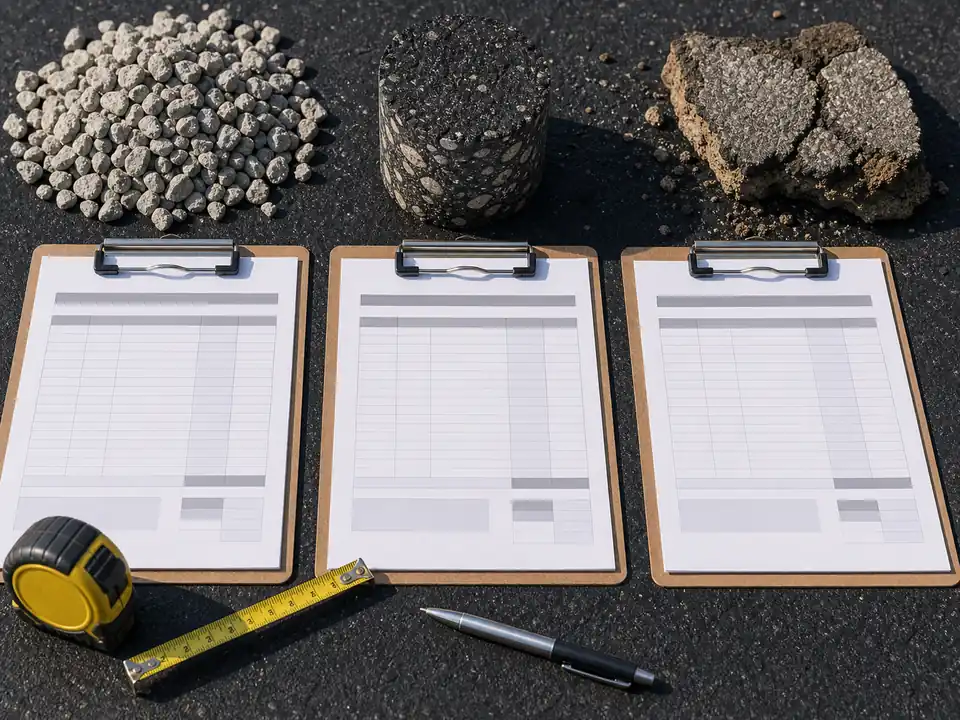
The driveway used in every example
To keep the numbers honest, all six examples use the same job. A 600 sq ft asphalt driveway. Suburban lot. Existing surface is old asphalt, cracked, near end of life. Mild slope, no major drainage issues. Standard residential use. Base rate on this job in 2026 is around 7 dollars per sq ft, so a base install runs about 4,200 dollars, in line with the 2026 Asphalt Driveway Cost Report. The 4,000 dollar spread on top of that base is what the next six sections explain. For per sq ft anchors see asphalt cost per square foot in 2026.
1. Compacted thickness assumption
This is the single biggest driver of variance. Asphalt is laid loose and rolled to a compacted thickness. Some contractors quote 2 inches compacted. Some quote 2.5. Some quote 3. On a 600 sq ft driveway, the difference between 2 and 3 inches is about 4 tons of asphalt, which is 600 to 1,200 dollars in material plus matching labor. Quotes that say "3 inch asphalt" without saying compacted are often laying 2.5 inch compacted, which is loose 3 inch. The National Asphalt Pavement Association publishes compaction guidance for residential mixes. Typical dollar impact: 700 to 1,400 dollars.
The same word, "thickness," can mean two completely different things. One contractor thinks loose. Another thinks compacted. Neither is lying. Until you nail down the unit, the comparison is broken. Always ask the question "is that loose or compacted?" before you read the price.
2. Base depth assumption
The base aggregate sits under the asphalt. It is half the life of the driveway. Cheap quotes assume 3 to 4 inches of crushed stone. Mid quotes assume 4 to 6 inches. Premium quotes assume 6 to 8 inches with geotextile fabric below in clay soils. On a 600 sq ft driveway, doubling the base depth adds 5 to 8 cubic yards of aggregate plus the labor to grade and compact it. The FHWA pavement program publishes subgrade and base prep standards used by reputable residential contractors. Typical dollar impact: 500 to 1,500 dollars.
3. Removal and tear-out scope
The biggest scope assumption is whether the old surface comes out or stays. A contractor who quotes a paving job often assumes you are clearing the driveway yourself. Another contractor on the same walk-through assumes tear-out is in scope. A third assumes overlay over the existing asphalt. Three different starting points, three different prices. On a 600 sq ft driveway:
- Tear-out of old asphalt: 600 to 1,200 dollars.
- Tear-out of old concrete: 1,200 to 2,400 dollars.
- Overlay (no removal): 0 dollars, but lifespan suffers if the base is bad. See resurface vs replace.
Typical dollar impact: 600 to 2,400 dollars. This is also where bad quotes hide. A 5,200 dollar quote that assumed overlay is not lying. It is just not the same job as the 7,400 dollar quote that included tear-out.
4. Drainage assumption
Grading the surface for runoff is in every quote. Actual drainage hardware is not. One contractor walks your driveway and sees the standing water at the garage door. He prices a trench drain. The next contractor walks the same driveway in dry weather and prices nothing. Same site, two reads. Typical drainage adders on a 600 sq ft driveway:
- Culvert under apron: 500 to 1,500 dollars.
- Trench drain at garage: 600 to 1,800 dollars.
- French drain along one side: 1,000 to 3,000 dollars.
Drainage variance alone can account for 1,000 to 2,000 dollars of spread. If your driveway has water issues, see the hidden costs guide for which scope to insist on. Typical dollar impact: 0 to 2,000 dollars.
5. Mobilization and crew size
Mobilization is the fixed cost of bringing paver, roller, transfer trucks, and a crew to your house. It runs 200 to 800 dollars on most residential jobs. A small local contractor with a single paver and a tight haul radius can mobilize for 200. A bigger company with longer hauls and a four-person crew may charge 800 just to show up. Crew size also varies. A two-person crew is cheaper per day but slower. A four-person crew is faster but billed at a higher day rate. The U.S. Bureau of Labor Statistics publishes paving operator wage data that explains regional labor swings. Typical dollar impact: 300 to 700 dollars.
6. Overhead, insurance, and margin
The last bucket is the contractor's cost of doing business. Real insurance, real worker's comp, real overhead, real margin. A reputable contractor carries 1 to 2 million dollars of liability insurance and runs 15 to 25 percent overhead on top of direct cost. A cheap quote may carry minimum coverage, no worker's comp, and 5 percent overhead. The price reflects that. The cheapest bid on a paving job is almost never cheaper because the contractor is more efficient. It is cheaper because the contractor is carrying less. The FTC home improvement contract guide covers what licensure and insurance should look like in a fair quote. Typical dollar impact: 500 to 1,500 dollars.
How the 4,000 spread maps to the six factors
Reading the example quotes from the top:
- 5,200 quote: 2 inch compacted asphalt. 3 inch base. Overlay over existing. No drainage. Minimum insurance. 5 percent overhead. Cheapest because it cut every assumption.
- 7,400 quote: 2.5 inch compacted. 5 inch base. Tear-out included. Surface grading only. Standard insurance. 18 percent overhead. The mid bid most homeowners pick.
- 9,100 quote: 3 inch compacted. 6 inch base. Tear-out included. Trench drain at garage. Full insurance. 22 percent overhead. The premium bid that will last 5 years longer.
None of the three contractors is lying. They are quoting three different driveways that happen to live at the same address. The spread is real, but it is also explainable.
How to bring the quotes back together
The cure is a written scope of work, handed to all three contractors. Write down what you want.
- Compacted asphalt thickness in inches (2.5 standard residential, 3 for heavy vehicles).
- Base aggregate depth in inches (5 to 6 standard, 6 to 8 for heavy vehicles).
- Tear-out scope (yes/no, what surface, who hauls).
- Drainage scope (none, culvert, trench drain, French drain).
- Permit responsibility (contractor pulls, customer pulls, no permit needed).
- Warranty length (1 year minimum, 3 to 5 year preferred).
Hand the same six lines to three contractors. The variance drops by 70 percent. Anything left is real. Read each line item with the read a quote like a pro guide first, then compare line by line with how to compare 3 paving quotes.
Why a regional contractor can quote lower than a national one
Two contractors quote the same job. One is the local pavers in your town who run two trucks. The other is a regional outfit with twelve trucks and an office two states away. The local outfit can mobilize for 250 dollars because the yard is six miles away. The regional outfit charges 700 because the haul is sixty miles. The local outfit may also have lower fixed overhead per job. Cheaper is not always corner-cutting. Sometimes it is geography. See cost by US region for how location stacks on top of these six factors.
Sample fair-bid range
For the same 600 sq ft suburban driveway, a fair-bid range in 2026 looks like this. Three honest quotes on a clean scope.
- Low bid: 6,200 to 6,800 dollars. 2.5 inch compacted, 5 inch base, tear-out included, no drainage.
- Mid bid: 7,000 to 7,800 dollars. 2.5 inch compacted, 5 to 6 inch base, tear-out, surface grading.
- High bid: 7,500 to 8,500 dollars. 3 inch compacted, 6 inch base, tear-out, drainage included.
That is a 2,000 to 2,500 dollar spread on the same scope, which is normal. A 4,000 dollar spread is a scope problem, not a market problem.
Bottom line
A 4,000 dollar spread between three asphalt quotes is almost always honest. Six common reasons (thickness, base, removal, drainage, mobilization, overhead) explain the gap. You can collapse most of it with a written scope. The cheapest quote is rarely magic. The most expensive is rarely a rip-off. They are usually quoting different driveways at the same address. Read each one carefully and the picture clears up. For warning signs that a cheap quote crossed the line into a lowball trap, see what lowball bids are hiding. Cost ranges, base prep standards, and tonnage references are on the sources page.