Two homeowners can get the same driveway built for very different money. One lives in New Jersey. One lives in Tennessee. Same 1,000 sq ft. Same 2.5 in compacted asphalt. The Jersey quote lands at 9,500 dollars. The Tennessee quote lands at 6,500. Neither contractor is scamming. Regional pricing is real. This guide walks the 2026 numbers by region and the four reasons behind the gap. The regional matrix here also anchors the 2026 Asphalt Driveway Cost Report. For an installed estimate on your own dimensions, use the driveway cost calculator.
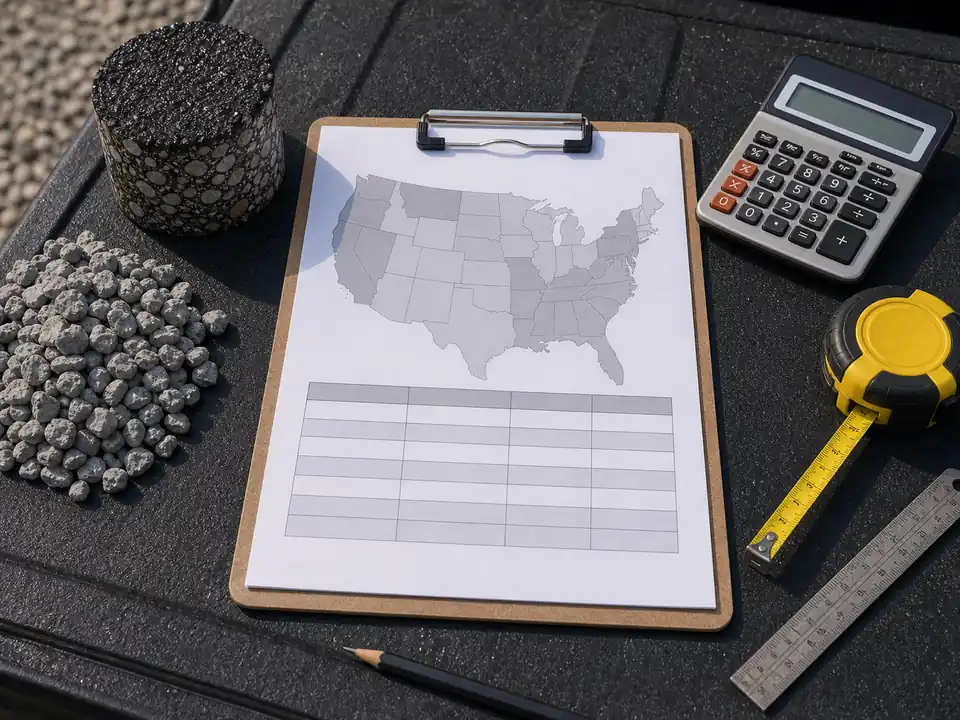
The 2026 regional picture in one table
All figures below are installed cost in 2026 for a 1,000 sq ft asphalt driveway on a flat lot with normal soil. Per-sq-ft math follows the per-sq-ft pricing guide. Hidden cost adders are covered in the hidden costs guide.
- Northeast (NY, NJ, MA, CT, PA): 7,500 to 11,000 dollars. 7.50 to 11 per sq ft.
- West Coast (CA, WA, OR): 7,500 to 11,000 dollars. 7.50 to 11 per sq ft.
- Southeast (TX, GA, FL, TN, NC, SC, AL): 5,500 to 8,000 dollars. 5.50 to 8 per sq ft.
- Midwest (OH, IN, IL, MI, WI): 6,000 to 8,500 dollars. 6 to 8.50 per sq ft.
- Mountain West (CO, UT, ID, MT, WY): 6,500 to 9,500 dollars. 6.50 to 9.50 per sq ft.
- Pacific Northwest (rural OR, WA, AK): 7,000 to 10,000 dollars. 7 to 10 per sq ft.
- Plains (KS, NE, OK, MO): 5,500 to 7,500 dollars. 5.50 to 7.50 per sq ft.
The four drivers behind regional variation
Quote spreads track four inputs. Three you can predict from a map. One you have to ask the contractor.
1. Labor cost
Wages for paving and surfacing equipment operators are tracked by the U.S. Bureau of Labor Statistics. The top five wage states pay 30 to 50 percent more than the bottom five. That alone moves a 1,000 sq ft quote by 1,500 to 2,500 dollars. Northeast and West Coast labor lead the country. Plains and Southeast labor sit lowest.
2. Plant distance
Hot mix asphalt has to leave the plant hot. Real working radius for a paver is about 30 to 60 miles. Past that, the mix cools and the contractor either adds hauling premium or refuses the job. Rural Mountain West, the Northern Plains, and parts of the Pacific Northwest sit far from the nearest plant. Expect a 500 to 2,000 dollar hauling line on long-distance jobs.
3. Paving season length
The National Asphalt Pavement Association publishes regional paving season data. Florida pavers can work 11 months. Minnesota pavers get 6 to 7. A short season concentrates demand. Crews book out. Shoulder-season discounts disappear. The best time to pave guide covers seasonal pricing in detail.
4. Climate severity
Cold winters need thicker pavement and deeper bases. Freeze-thaw cycles break thin sections. A standard residential spec in Maine runs 3 in compacted asphalt on 6 to 8 in of base. A standard spec in Georgia runs 2 to 2.5 in on 4 in of base. That spec difference alone adds 0.50 to 1.50 dollars per sq ft. The lifespan guide covers why northern driveways need more material to last.
Northeast: high labor, short season, deep bases
New York, New Jersey, Massachusetts, Connecticut, Eastern Pennsylvania. Expect 7.50 to 11 dollars per sq ft installed. Urban Boston and metro New York skew higher. Western Pennsylvania and upstate New York skew lower. The combination of high wages, short paving window, and deep freeze-thaw exposure pushes the per-sq-ft rate above the national mean by 1 to 3 dollars. Standard residential spec runs 2.5 to 3 in compacted asphalt on 6 to 8 in of crushed stone base.
West Coast: high labor, dense market
California, Washington, Oregon. Expect 7.50 to 11 dollars per sq ft installed. Coastal California cities run highest in the country alongside the New York metro. Inland California, eastern Oregon, and eastern Washington drop into the 6 to 8 range. Labor cost is the dominant driver. Climate is mild, so bases stay closer to 4 to 6 in. Permits and noise rules in urban California can add 200 to 500 dollars.
Southeast: cheapest in the country
Texas, Georgia, Florida, Tennessee, North Carolina, South Carolina, Alabama, Mississippi. Expect 5.50 to 8 dollars per sq ft installed. Florida and metro Atlanta cluster near 7. Rural Tennessee and Alabama can drop under 6. Lower labor rates, long paving seasons, and dense plant coverage keep the market lean. Sun-heavy states often spec a slightly harder binder to slow UV damage. The cost calculator shows installed totals on your area.
Midwest: mid-market with freeze-thaw
Ohio, Indiana, Illinois, Michigan, Wisconsin, Iowa, Minnesota. Expect 6 to 8.50 dollars per sq ft installed. Chicago metro skews higher. Rural Indiana and Iowa skew lower. Quotes track the national average closely. Cold winters argue for 6 to 8 in of base under 2.5 in compacted asphalt. Minnesota and Wisconsin push base depth higher in heavy frost zones.
Mountain West: clay soils and altitude
Colorado, Utah, Idaho, Montana, Wyoming. Expect 6.50 to 9.50 dollars per sq ft installed. Front Range Colorado and Salt Lake City sit closer to 8. Rural Montana and Wyoming can hit 9 once hauling premiums hit. Expansive clay and high-altitude freeze-thaw push a stronger base spec. Plan for 8 in of crushed stone under 2.5 to 3 in compacted asphalt. Drainage matters more here than in flat regions.
Pacific Northwest: wet climate, long hauls outside cities
Western Oregon, Western Washington, coastal Alaska. Expect 7 to 10 dollars per sq ft installed. Seattle and Portland metros sit closer to the West Coast band. Rural Olympic Peninsula, the Oregon Coast, and Southeast Alaska carry plant-distance premiums of 500 to 1,500 dollars. Wet climate puts pressure on drainage and crown. Skip the drainage scope and the surface fails fast.
Plains: lowest combined cost
Kansas, Nebraska, Oklahoma, Missouri, Arkansas. Expect 5.50 to 7.50 dollars per sq ft installed. Wichita, Tulsa, Omaha, and Kansas City quotes sit at or just under the national average. Lower labor and decent plant coverage explain most of the gap. Tornado country adds a separate cost: high-wind rated mailboxes and edge anchors that some homeowners ask the paver to set, which is a small adder, not a paving premium.
What does not vary by region
Three line items stay nearly flat coast to coast. The asphalt material itself, when priced per ton at the plant, varies less than 20 percent across the country. Equipment costs (paver, roller, transfer trucks) are national. Insurance and overhead percentages run similar. The variation is almost entirely labor, hauling distance, and the spec depth set by climate. The real bill breakdown separates the labor share from the material share.
How to use regional data when you get quotes
Convert each written quote to per-sq-ft. Compare to your regional band above. Three useful checks:
- If your quote falls under the lower bound of your region by more than a dollar per sq ft, look for missing scope. Common cuts are thin asphalt, no real base, no tear-out, or an uninsured crew. The contractor red flags guide covers patterns.
- If your quote falls above the upper bound by more than a dollar per sq ft, ask what is included. Drainage scope, retaining edges, premium thickness, and long hauls show up here. Not necessarily expensive. Often scoped.
- Compare three quotes from contractors based within 20 miles of you. Wide swings inside a 20-mile radius are not regional. They are scope or margin. The contractor selection guide walks how to vet.
Check each contractor on the Better Business Bureau for prior dispute patterns. Run the final quote through the quote checker before you sign. The paving contract checklist covers terms that should be in writing in every state.
Bottom line
Regional variation is real and predictable. Northeast and West Coast run 1 to 3 dollars per sq ft over the national mean. Southeast and Plains run a dollar under. Mountain West and Pacific Northwest sit a touch over due to plant distance and stronger specs. Use your regional band as the sanity check. Inside that band, the quote-to-quote spread comes from scope, not your zip code.
Range references, BLS wage data, and base prep standards are on the sources page.